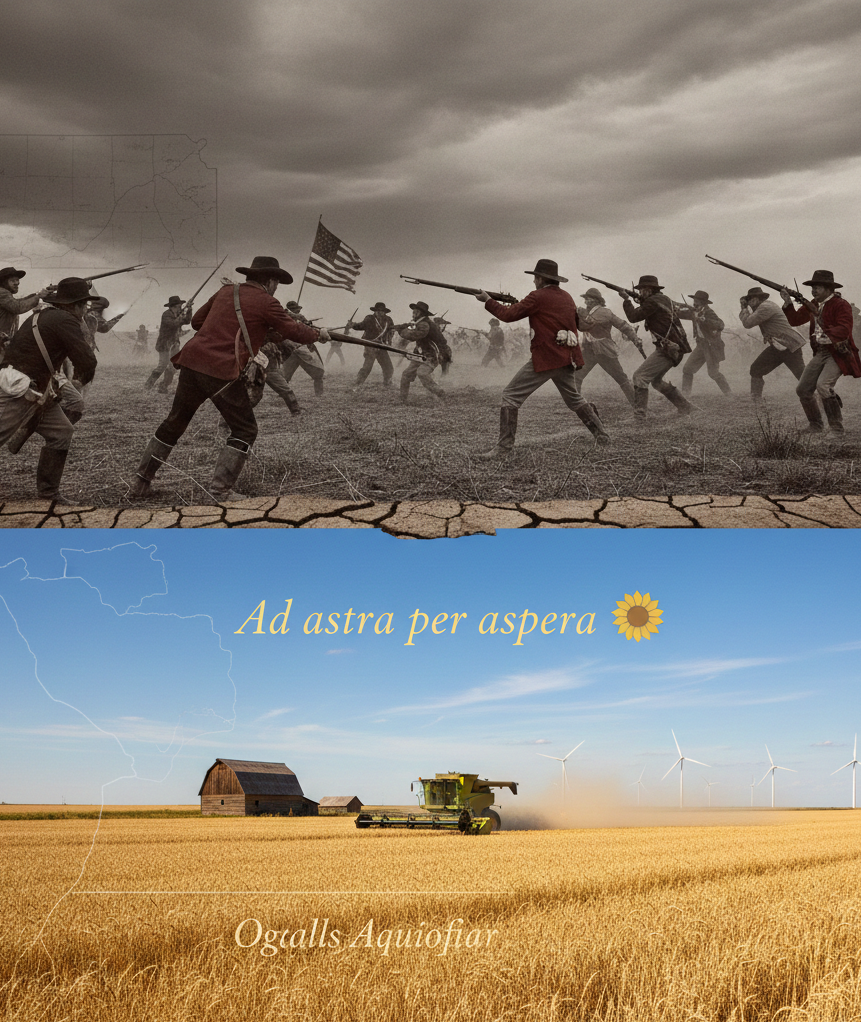
Hashtags
#Kansas #SunflowerState #BleedingKansas #AmericanHistory #Midwest #Agriculture #Breadbasket #OgallalaAquifer #AdAstraPerAspera
Kansas: The Sunflower State’s Journey from Bleeding Battleground to America’s Breadbasket
Kansas occupies a peculiar position in the American imagination—simultaneously central to the nation’s geography and peripheral to its cultural consciousness, dismissed as flyover country by coastal elites while embodying quintessentially American values of self-reliance, agricultural productivity, and stubborn independence. The state’s flat prairie landscape, stretching endlessly toward horizons interrupted only by grain elevators and the occasional windbreak of trees, conveys monotony to hurried travelers but conceals a history as dramatic and consequential as any region in the nation. From the violent territorial struggles that previewed the Civil War to the agricultural innovations that transformed global food production, Kansas has shaped American development in ways that its modest contemporary profile barely suggests.
Understanding Kansas requires looking beyond the stereotypes of wheat fields and tornadoes to recognize how geography, ideology, and economic necessity combined to create a state whose character reflects both triumph over harsh environmental conditions and ongoing struggles with the consequences of resource depletion and economic transformation. The sunflower that serves as the state’s symbol captures this duality perfectly—a hardy native plant thriving in difficult conditions while turning its face toward the sun, embodying the optimistic resilience that Kansans consider their defining characteristic. The state motto “Ad astra per aspera”—to the stars through difficulty—isn’t mere poetic flourish but accurate description of a place where achievement has always required overcoming formidable obstacles.
The Identity of the Sunflower State
The Kansas City metropolitan area presents one of America’s most confusing geographic anomalies for anyone unfamiliar with the region—a major city whose name implies singular identity but whose reality encompasses two distinct municipalities separated by a state line running directly through the urban core. Kansas City, Missouri, and Kansas City, Kansas, function as separate cities with different governments, tax structures, and legal frameworks while sharing an integrated economy, interconnected transportation networks, and common cultural identity that makes the state line feel arbitrary to residents who cross it multiple times daily for work, entertainment, or shopping.
This dual nature creates both practical complications and amusing situations. Residents must navigate different tax rates on either side of the state line, with substantial variation in sales taxes, property taxes, and income taxes that incentivize strategic decisions about where to live, work, and make major purchases. The tax differential has spawned border shopping behaviors where Kansas residents cross into Missouri for certain purchases while Missouri residents head to Kansas for others, depending on which jurisdiction offers better deals for specific goods and services. Legal differences extend beyond taxes to alcohol regulations, marijuana policies, and countless municipal ordinances that vary between the two states despite the cities’ functional integration.
Kansas’s broader transition from violent territorial battleground to conservative agricultural powerhouse reflects profound changes in American politics, economics, and regional development patterns. The state that once represented the bleeding edge of the slavery debate—literally bleeding, as we’ll explore—evolved into one of America’s most reliably Republican jurisdictions, where agricultural interests, social conservatism, and small-government ideology create political dynamics vastly different from the radical abolitionism that defined territorial Kansas. This transformation illustrates how places’ political identities can shift dramatically across generations as demographic changes, economic transformations, and evolving national political alignments reshape local cultures and voting patterns.
The Divergent Paths of KCK and KCMO
The historical foundations of the Kansas City naming confusion trace back to Missouri’s City of Kansas predating Kansas statehood by several years. Founded in 1850 and incorporated in 1853, the City of Kansas on the Missouri side of the state line established itself as a significant Missouri River port and trading center before Kansas even existed as a state. The city’s name derived from the Kansa Native American tribe that historically inhabited the region, and its early growth reflected strategic positioning at the confluence of the Kansas and Missouri Rivers where waterborne commerce made fortunes for merchants and traders serving westward expansion.
When Kansas achieved statehood in 1861, settlements on the Kansas side of the state line faced identity challenges—they existed within the orbit of the established Missouri city but lacked the infrastructure, population, or economic development to compete as independent entities. The strategic decision by Kansas authorities to consolidate various small settlements in Wyandotte County under the Kansas City, Kansas, name in 1872 represented calculated opportunism, deliberately appropriating the established Kansas City brand to “profit off” the Missouri city’s success and recognition. This naming choice allowed the Kansas side to benefit from association with its larger, more prosperous neighbor while maintaining separate governance under Kansas jurisdiction.
The competitive relationship between KCK and KCMO has fluctuated between cooperation and rivalry throughout their parallel histories. Economic development competitions see the two states offering different tax incentives and regulatory environments to attract businesses, with some companies strategically locating right along the state line to maximize advantages from both jurisdictions. Major employers including sports franchises have leveraged interstate competition to extract favorable deals, with the Kansas City Chiefs and Kansas City Royals securing stadium improvements and public subsidies by hinting at potential relocations across the state line.
State line realities create fascinating situations where neighbors living on opposite sides of the same street face dramatically different tax burdens and public services. Property taxes, school funding, and municipal services vary substantially between Kansas and Missouri sides of the metropolitan area, creating incentives for households to strategically choose their residence based on which state’s overall package of taxes and services better suits their circumstances. High-income earners might prefer Kansas’s lower income tax rates, while families might evaluate school quality and property taxes in making residence decisions that carry multi-thousand-dollar annual financial implications based purely on which side of an arbitrary line they choose.
Despite these jurisdictional complications, the Kansas City metropolitan area maintains cohesive cultural bonds that transcend state boundaries. Residents identify as Kansas Citians rather than primarily as Missourians or Kansans, supporting the same sports teams, patronizing the same cultural institutions, and participating in the same regional economy regardless of which side of State Line Road they call home. This shared metropolitan identity demonstrates how cultural and economic integration can overcome political boundaries, creating functional regions that operate as unified entities despite formal governmental fragmentation.
“Bleeding Kansas” and the Struggle for Freedom
The 1854 Kansas-Nebraska Act represents one of the most consequential pieces of legislation in American history, directly contributing to the political polarization and violence that culminated in Civil War seven years later. The Act, championed by Illinois Senator Stephen Douglas, applied the doctrine of “popular sovereignty” to the Kansas and Nebraska territories, allowing settlers rather than Congress to determine whether these territories would permit slavery. This seemingly democratic approach to the slavery question actually intensified conflict by transforming the territories into battlegrounds where pro-slavery and anti-slavery forces competed to establish majority populations that could control territorial governments and eventually determine statehood conditions.
The popular sovereignty mechanism triggered massive migration to Kansas from both slaveholding states and free states, with each side attempting to establish demographic dominance through sheer numbers of settlers. Pro-slavery Missourians, nicknamed “Border Ruffians,” crossed into Kansas to vote in territorial elections despite not residing there, while anti-slavery settlers funded by Northern abolition societies poured into the territory determined to prevent slavery’s expansion. This competitive migration and electoral fraud created a toxic political environment where neither side accepted the legitimacy of territorial governments and violence became the primary mechanism for resolving disputes.
The Sacking of Lawrence in May 1856 escalated territorial violence to new levels when pro-slavery forces attacked the free-state stronghold of Lawrence, destroying newspaper offices, burning the Free State Hotel, and ransacking homes and businesses. The attack, characterized by historians as more vandalism than massacre since only one person died, nonetheless represented a terrifying assertion of pro-slavery willingness to use violent intimidation against antislavery settlers. The destruction of Lawrence galvanized Northern opinion and triggered retaliatory violence that pushed the territory toward open guerrilla warfare.
John Brown’s Pottawatomie massacre three days after the Sacking of Lawrence demonstrated the extreme violence that radical abolitionists were willing to employ in response to pro-slavery aggression. Brown and his followers murdered five pro-slavery settlers along Pottawatomie Creek in Franklin County, hacking them to death with broadswords in a calculated terrorist attack designed to strike fear into pro-slavery communities and demonstrate that antislavery forces would respond to violence with even greater brutality. Brown’s actions horrified many antislavery settlers who rejected violence even while opposing slavery, but they also showed that antislavery forces wouldn’t be intimidated into abandoning Kansas to pro-slavery control.
The violence throughout the territory earned it the nickname “Bleeding Kansas” as guerrilla warfare between pro-slavery and antislavery militias terrorized settlers, destroyed property, and left approximately 200 people dead over several years of intermittent conflict. This violence previewed the Civil War’s savagery and demonstrated that the slavery question could not be resolved through compromise or democratic processes—one side would need to decisively defeat the other through force.
The path to Kansas statehood remained blocked by pro-slavery Congressional representatives who refused to admit Kansas as a free state while they maintained power to prevent it. The political deadlock broke only when Southern senators and representatives resigned their seats following secession in 1861, eliminating the pro-slavery Congressional bloc that had prevented Kansas admission. With Southern opposition removed, Kansas quickly achieved statehood on January 29, 1861, as a free state under a constitution prohibiting slavery—the outcome that all the territorial violence had been fought to determine.
Natural Resources and Sustaining Life
The Ogallala Aquifer, also known as the High Plains Aquifer, represents one of the world’s largest underground freshwater sources, extending from South Dakota through Nebraska, Wyoming, Colorado, Kansas, Oklahoma, New Mexico, and into Texas. This massive groundwater reservoir has enabled agricultural development across the Great Plains that would otherwise be impossible given the region’s semi-arid climate and insufficient surface water for large-scale irrigation. Kansas farmers have relied heavily on Ogallala water to irrigate crops since the mid-20th century when improved well-drilling technology and center-pivot irrigation systems made accessing the deep aquifer economically viable.
However, the Ogallala faces a critical sustainability crisis as extraction rates vastly exceed natural recharge, with some estimates suggesting the aquifer requires approximately 280 years to replace groundwater being pumped out in a single year under current usage patterns. This catastrophic imbalance means that Ogallala-dependent agriculture is fundamentally unsustainable, mining an exhaustible resource rather than operating within the aquifer’s renewable capacity. Water table levels have dropped dramatically across much of Kansas, with some areas experiencing declines exceeding 100 feet since large-scale irrigation began, making pumping increasingly expensive as farmers must drill deeper wells and use more energy to lift water from greater depths.
The water crisis forces difficult choices about agricultural futures in western Kansas, where communities built on irrigated agriculture face potential economic collapse as the aquifer depletes beyond economically viable pumping depths. Some farmers have already abandoned irrigation and returned to dryland farming with dramatically reduced yields, while others invest in more efficient irrigation technologies and precision agriculture techniques attempting to maintain productivity with less water. The tragedy-of-the-commons dynamics complicate conservation efforts, as individual farmers have economic incentives to pump aggressively while they can rather than conserving for a future where they might not remain in business.
Kansas agriculture has undergone dramatic shifts since settlement, with early farmers initially attempting to replicate the corn and livestock operations common in more humid regions to the east. These attempts largely failed as periodic droughts devastated crops and the climate proved too harsh for the agricultural systems that worked in Iowa or Illinois. The transition to hard winter wheat—varieties planted in fall, establishing root systems before winter, then resuming growth in spring to harvest in early summer—proved far better adapted to Great Plains conditions. Winter wheat utilizes fall and spring moisture while avoiding the worst summer heat, producing reliable yields in climates where spring-planted crops frequently fail.
This wheat specialization transformed Kansas into America’s breadbasket, with the state consistently ranking among national leaders in wheat production. The hard red winter wheat varieties that thrive in Kansas became essential for bread flour, creating global demand that still sustains the state’s agricultural economy despite ongoing challenges from water depletion and commodity price volatility.
The sunflower’s role as state symbol reflects both botanical fact and aspirational symbolism perfectly suited to Kansas’s self-image. Wild sunflowers native to the Great Plains demonstrate remarkable toughness, thriving in harsh conditions that defeat less adapted species, turning their faces toward the sun even in blazing summer heat when temperatures exceed 100 degrees for weeks at a time. The plant’s deep taproots access soil moisture unavailable to shallow-rooted species, while its drought tolerance allows survival through the periodic droughts that characterize Plains climate.
Kansas officially adopted the sunflower as state flower in 1903, recognizing both the plant’s biological significance in native ecosystems and its symbolic resonance with state character. The sunflower’s combination of beauty and utility—providing seeds for wildlife food, stabilizing soil, and adding visual interest to otherwise monotonous landscapes—mirrors Kansans’ self-conception as practical people who appreciate beauty but value function and resilience above aesthetic refinement.
Modern Kansas: Economics and Legacy
Kansas’s fiscal health presents a mixed picture of conservative financial management, ongoing budget tensions, and the recurring political battles over tax policy that have defined the state for decades. The State General Fund, which finances core government services including education, social services, and public safety, operates under balanced budget requirements that prevent deficit spending common at the federal level. This fiscal constraint forces difficult tradeoffs when revenues decline or spending needs increase, creating political conflicts between those prioritizing lower taxes and those advocating for greater public investment.
The 2025 legislation regarding individual income taxes continues Kansas’s decades-long debate about optimal tax policy, with conservative legislators pushing for rate reductions they argue stimulate economic growth by allowing residents to keep more of their earnings, while opponents counter that tax cuts primarily benefit high earners while starving essential public services of necessary funding. The state’s experience with dramatic tax cuts under former Governor Sam Brownback—which produced budget crises and were ultimately reversed—makes current debates particularly contentious, with both sides citing that experience as evidence for their positions.
Cultural contributions from Kansas punch well above the state’s population weight, with the band Kansas achieving global recognition through 1970s progressive rock hits including “Carry On Wayward Son” and “Dust in the Wind.” These songs, still receiving extensive radio airplay and streaming five decades after their release, represent Kansas’s most successful musical export and create cultural associations far exceeding what a state of 3 million people might typically generate.
Kansas sports history features legendary achievements in college basketball, with the University of Kansas Jayhawks representing one of college basketball’s blue-blood programs under coaching legends including Phog Allen and more recently Bill Self. The Jayhawks’ tradition of excellence, multiple national championships, and consistent tournament success have made Kansas basketball a point of intense state pride and national recognition.
Professional sports presence is complicated by the Kansas City metropolitan split, with the Chiefs and Royals technically residing in Missouri despite “Kansas City” in their names. However, many Kansas residents strongly support these teams and consider them part of Kansas identity regardless of the jurisdictional technicalities. Recent Chiefs success, including multiple Super Bowl victories, has provided the region shared sports triumphs that transcend state boundaries.
Conclusion: The Enduring Spirit of “Ad Astra Per Aspera”
The state motto “Ad astra per aspera”—to the stars through difficulty—captures Kansas history and character with remarkable concision. The state’s journey from violent territorial battleground through agricultural settlement of harsh landscapes to contemporary challenges of water depletion and economic transformation represents continuous navigation of difficulty in pursuit of aspirational goals. Early settlers faced environmental hardships that defeated countless homesteaders, requiring extraordinary persistence and adaptation to establish viable communities in semi-arid grasslands far from markets and support systems.
The spirit embodied in this motto manifests in Kansan responses to ongoing challenges including aquifer depletion, rural population decline, and economic transformations threatening traditional agricultural livelihoods. Rather than abandoning the state or accepting decline as inevitable, many Kansans demonstrate the same stubborn determination that characterized original settlement, seeking innovative solutions to sustainability challenges, developing new economic opportunities, and maintaining community cohesion despite demographic and economic pressures.
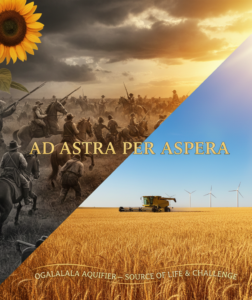
This resilient optimism, symbolized by sunflowers turning toward the sun even in hostile conditions, defines Kansas identity more fundamentally than any particular policy position or economic statistic. The state faces genuine challenges that will require difficult adaptations and sacrifice to overcome—water conservation demands reducing agricultural production, economic diversification requires abandoning comfortable reliance on traditional industries, and demographic realities mean some communities will inevitably decline. Yet the motto suggests that these difficulties represent not insurmountable obstacles but rather the expected terrain of continued progress toward aspirational futures.
Kansas may never dominate national consciousness the way coastal states do, may never achieve the population or economic scale of Texas or California, and may always fight stereotypes about flyover irrelevance. But the state’s contributions to American history through the antislavery struggle, to global food security through agricultural innovation, and to cultural life through music and sports exceed what mere population numbers would predict. The sunflower state, turning its face toward the sun while roots dig deep into difficult soil, endures—not despite difficulty but perhaps because of it, with character forged by the challenges that would have defeated less determined people. That determination, that insistence on reaching for the stars regardless of the difficulties, remains Kansas’s defining characteristic and most valuable legacy.