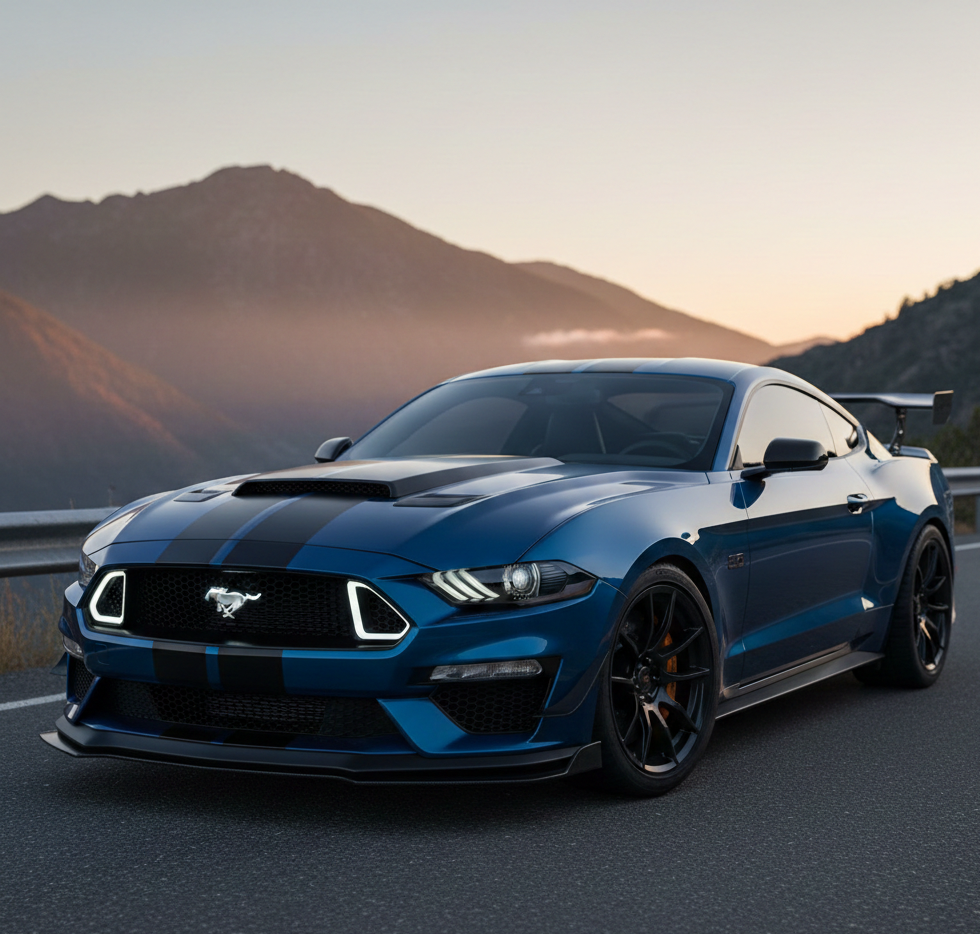
Enhanced with a dual-clutch transmission, advanced variable traction control, forged suspension components, and an optional Track Pack featuring carbon fiber and magnesium weight-saving elements, the Dark Horse SC is engineered as a true circuit-capable muscle car. As regulatory pressure threatens the future of high-performance V8s, the Dark Horse SC stands as a potential final chapter in factory-warrantied, supercharged American muscle—blending heritage, modern technology, and visceral driving engagement
Hashtags
#MustangDarkHorseSC #2026Mustang #FordPerformance #SuperchargedV8 #AmericanMuscle #TrackCar #GT500Successor #MuscleCarEra #DarkHorse
The 2026 Ford Mustang Dark Horse SC: Supercharged Performance Redefining American Muscle
Ford’s introduction of the 2026 Mustang Dark Horse SC represents a calculated gamble that the venerable pony car can reclaim performance credibility against increasingly capable European sports cars and domestic rivals while maintaining the raw, visceral character that defines American muscle. The “SC” designation—standing for “supercharged”—evokes legendary Ford performance nameplates from eras when forced induction separated mere fast cars from genuine performance icons capable of embarrassing machinery costing twice as much. By grafting a supercharger onto the already formidable 5.2-liter Voodoo V8 from the standard Dark Horse, Ford creates a vehicle occupying the performance territory previously claimed by the discontinued Shelby GT500 while maintaining the Dark Horse’s driver-focused ethos that prioritizes engagement over outright numbers.
This positioning proves strategically brilliant—the GT500 had evolved into a technological tour de force featuring dual-clutch transmissions, adaptive suspension, and near-800 horsepower outputs that demanded sophisticated electronic intervention to remain controllable by mortals. The Dark Horse SC deliberately retreats from that technological arms race, offering supercharged power delivery in a package that feels more connected and less insulated than the GT500’s computer-managed approach. For enthusiasts who found the GT500 too sanitized, too removed from the mechanical directness that makes driver’s cars special, the Dark Horse SC represents a welcome return to performance that requires driver skill rather than merely driver inputs that sophisticated computers interpret and execute.
Overview of the 2026 Ford Mustang Dark Horse SC as a Performance Bridge
The Dark Horse SC occupies fascinating territory in Ford’s performance hierarchy, functioning as the bridge between the standard Dark Horse—already a serious track weapon—and the stratospheric performance of the now-discontinued GT500. This positioning addresses a genuine gap in the Mustang lineup where enthusiasts seeking more power than the standard Dark Horse’s 500 horsepower but unwilling to pay GT500 prices or accept its technological complexity had limited options. The SC designation immediately communicates forced induction to knowledgeable enthusiasts while avoiding the Shelby branding that carries specific expectations around exclusivity and price points.
The significance of the “SC” designation in Ford’s high-performance history extends beyond mere alphabetic coincidence—it deliberately evokes memories of legendary supercharged Ford products including the 2003-2004 SVT Mustang Cobra with its Eaton supercharger, various Lightning trucks, and other factory-supercharged performance vehicles that occupied special places in enthusiast consciousness. By reviving the SC nomenclature, Ford signals that the Dark Horse supercharged variant represents more than a simple power upgrade but rather a distinct performance philosophy emphasizing tractable, usable power delivery rather than headline-grabbing peak numbers that require perfect conditions and professional driver skill to access.
The performance bridge concept proves particularly valuable given contemporary automotive market realities where electrification pressures, tightening emissions regulations, and uncertain legislative environments for internal combustion performance threaten the long-term viability of high-horsepower naturally aspirated and supercharged engines. The Dark Horse SC potentially represents one of the final opportunities for enthusiasts to purchase a new, factory-warrantied supercharged V8 muscle car before regulations or market forces make such vehicles economically unviable or legally impossible. This end-of-an-era quality adds emotional weight and potential collectibility to the model beyond its objective performance capabilities.
Engine and Performance Specs
The supercharged 5.2-liter V8 powertrain at the Dark Horse SC’s heart represents evolutionary refinement of Ford’s celebrated flat-plane-crank Voodoo engine rather than revolutionary redesign. The standard Dark Horse already extracts impressive performance from this naturally aspirated architecture, but forced induction transforms the engine’s character dramatically. The supercharger—likely a roots-type positive displacement unit similar to those used on previous supercharged Mustang variants—provides immediate throttle response and linear power delivery throughout the rev range that contrasts sharply with the peaky, high-revving nature of naturally aspirated flat-plane V8s.
Estimated output figures for the supercharged combination likely approach 700-750 horsepower depending on final boost levels, intercooling efficiency, and fuel system capacity. This output range positions the Dark Horse SC squarely between the standard Dark Horse’s 500 horsepower and the GT500’s nearly 800 horsepower, creating meaningful performance separation while avoiding the extreme outputs that stress drivetrain components and tire technology beyond street usability. The power delivery characteristics should emphasize midrange torque—the supercharger generating substantial boost from low engine speeds—creating acceleration that feels more effortless than the standard car’s need to reach high RPMs before delivering maximum performance.
The flat-plane crankshaft design that gives the Voodoo engine its distinctive high-revving character and exotic exhaust note introduces both advantages and challenges when combined with supercharging. The balanced crankshaft design allows higher redlines and faster engine acceleration than traditional cross-plane V8s, but it also creates greater vibration that must be managed through engine mounts and harmonic dampers. Supercharging adds thermal stresses and increased cylinder pressures that require careful calibration to prevent detonation or mechanical damage, likely necessitating lower compression ratios than the naturally aspirated version to provide safe margins when operating under boost.
The 7-speed dual-clutch transmission represents critical technology enabling the Dark Horse SC to translate engine power into track performance that manual transmissions cannot match regardless of driver skill. DCT technology provides lightning-fast gear changes measured in milliseconds rather than the fractions of seconds even expert manual transmission drivers require, allowing the engine to remain in its power band through rapid-fire upshifts during acceleration and precisely timed downshifts during braking zones. The transmission’s electronic control integrates with throttle management and traction control systems to optimize power delivery in ways that manual transmissions cannot replicate.
Track performance demands on transmissions extend far beyond simple gear ratio selection to encompass thermal management, launch control integration, and consistent repeatability through extended sessions where fluid temperatures soar and components endure punishing loads. The DCT’s wet-clutch design provides superior thermal capacity compared to manual clutches, dissipating heat through circulating transmission fluid rather than concentrating thermal energy in a single friction surface. This thermal advantage allows harder launches and more aggressive driving before clutch temperatures reach dangerous levels that would force manual transmission drivers to back off to prevent damage.
The Track Package and Aerodynamics
The Track Pack Special Edition elevates the Dark Horse SC from impressive street performance car to genuine track weapon through comprehensive aerodynamic, structural, and weight-reduction modifications addressing the specific demands of circuit driving. The Carbon Exterior Package replaces heavy steel and aluminum components with carbon fiber alternatives, reducing mass while adding visual aggression through the distinctive weave pattern that signals serious performance intent. Specific components likely include front splitter, side sills, rear diffuser, and possibly hood or roof panels depending on how aggressively Ford pursues weight reduction.
The black-painted roof serves both aesthetic and functional purposes—visually lowering the car’s perceived center of gravity while potentially providing modest thermal benefits by reflecting less solar heat than lighter colors. The blacked-out roof treatment integrates with the overall murdered-out aesthetic that Track Pack cars embrace, creating cohesive visual identity distinguishing them from standard Dark Horse models. While the actual structural or performance benefits of roof color prove negligible, the psychological impact of a coordinated performance appearance shouldn’t be dismissed for enthusiasts who value the total ownership experience beyond mere lap times.
Weight reduction strategies employing magnesium strut towers represent genuine performance engineering rather than cosmetic modifications masquerading as functional upgrades. Magnesium offers superior strength-to-weight ratios compared to steel or aluminum, allowing structural components to maintain required stiffness while reducing mass that contributes nothing to performance. Strut towers endure substantial loads during aggressive driving as suspension forces transmit through them into the chassis, making them excellent candidates for lightweight materials that reduce unsprung weight—mass that suspension must control—improving ride quality, handling precision, and tire compliance over surface irregularities.
Carbon fiber wheels potentially deliver even more dramatic unsprung weight reduction compared to conventional aluminum wheels, with some carbon wheel designs achieving 40-50% weight reduction versus equivalent aluminum wheels. Reducing rotational mass at the wheels provides multiple benefits beyond simple weight reduction—lighter wheels require less force to accelerate rotationally during acceleration and decelerate during braking, improving both performance metrics. Additionally, reduced unsprung mass allows suspension to maintain better tire contact with road surfaces over bumps and undulations, improving both grip levels and driver confidence when pushing limits on imperfect track surfaces.
However, carbon fiber wheels introduce durability concerns that aluminum wheels don’t face—carbon’s brittleness makes it vulnerable to catastrophic failure from impacts that aluminum wheels would survive with repairable bending. Track driving subjects wheels to substantial impacts from curbs, debris, and aggressive driving over rough surfaces, creating real risks of expensive carbon wheel damage that budget-conscious enthusiasts must consider when evaluating whether Track Pack’s benefits justify its additional costs and potential repair expenses.
Advanced Driving Technology
The Variable Traction Control system implementation represents sophisticated electronic intervention allowing drivers to tailor vehicle behavior to specific conditions, driving styles, and skill levels. Unlike binary traction control systems that operate fully on or completely off, variable systems provide multiple intervention levels ranging from aggressive intervention allowing minimal wheelspin to nearly disabled modes permitting substantial slip before electronic intervention reduces power or applies selective braking. This flexibility proves invaluable on track where different corners, surface conditions, and driver preferences require different traction management approaches.
The system likely integrates data from wheel speed sensors, steering angle sensors, lateral and longitudinal accelerometers, and possibly even GPS positioning to understand vehicle dynamics and driver intentions. Advanced algorithms analyze this sensor data in real-time, distinguishing between productive wheelspin that accelerates the car efficiently and excessive slip that wastes power while degrading tire life. The system can then intervene with appropriate aggression—allowing experienced drivers substantial freedom while preventing novices from making catastrophic mistakes that damage vehicles or endanger themselves.
Track-focused traction control modes should permit controlled drifts and power oversteer that would trigger immediate intervention in street-oriented stability systems, recognizing that skilled drivers intentionally use these techniques for optimal lap times on certain corners. However, even in permissive modes, the system should prevent truly dangerous situations where complete loss of control becomes likely, providing safety nets that allow drivers to explore handling limits without crossing into genuinely dangerous territory requiring professional driver skill to recover.
The transition from steel to forged suspension links delivers tangible improvements in suspension precision and driver feedback that enthusiasts notice immediately during spirited driving. Steel stamped suspension components flex under cornering loads, introducing compliance that dulls steering response and creates imprecise handling where driver inputs don’t translate directly into vehicle behavior. Forged components offer dramatically improved stiffness-to-weight ratios, maintaining dimensional stability under loads that would flex stamped steel components, creating the immediate steering response and predictable handling that define great driver’s cars.
Enhanced feedback manifests as improved communication about tire grip levels, weight transfer, and chassis balance that allows skilled drivers to extract maximum performance by operating closer to adhesion limits. When suspension components maintain precise geometry under cornering loads, drivers receive clearer information about exactly how much grip remains available, when tires approach their limits, and how the chassis will respond to control inputs. This transparency separates good-handling cars that merely go around corners quickly from great-handling cars that engage drivers through rich feedback and predictable responses rewarding precision and skill.
Technical Setup & Maintenance (Owner/Installer Perspective)
For enthusiasts considering aftermarket supercharger installations on existing Dark Horse or GT models, understanding critical installation steps prevents catastrophic mistakes that destroy engines or create dangerous reliability issues. Professional installation by experienced shops with dyno tuning capabilities proves essential unless owners possess substantial mechanical expertise and appropriate tools. Supercharger kits require extensive modifications including intake manifold replacement, fuel system upgrades, exhaust modifications, and comprehensive engine management calibration that amateur installations frequently botch with expensive consequences.
Critical installation considerations begin with fuel system capacity—supercharged engines consume dramatically more fuel than naturally aspirated versions, potentially exceeding stock fuel pump and injector capacity. Inadequate fuel delivery creates dangerously lean air-fuel ratios under boost that cause detonation and catastrophic engine damage within seconds. Upgraded fuel pumps and larger injectors typically accompany serious supercharger installations, along with comprehensive dyno tuning ensuring proper fuel delivery across all operating conditions from idle through full-throttle wide-open-throttle pulls.
Engine management calibration represents the most critical aspect separating successful supercharger installations from expensive disasters. The ECU must reduce ignition timing under boost to prevent detonation, enrichen fuel mixtures to provide safe air-fuel ratios and cooling, and potentially limit boost levels in lower gears or specific conditions to prevent drivetrain damage. Professional tuners with extensive experience calibrating forced induction engines prove invaluable, as they understand the subtle calibration compromises between maximum power, reliability, and drivability that novice tuners often misjudge.
Maintenance essentials for supercharged engines differ significantly from naturally aspirated requirements, beginning with oil selection. The specified 5W-50 synthetic oil provides superior high-temperature protection compared to lighter viscosity oils, maintaining protective film strength under the elevated temperatures and pressures that forced induction creates. Some owners attempt using lighter oils seeking marginal power gains from reduced friction, but this penny-wise, pound-foolish approach risks expensive engine damage to save negligible amounts while potentially voiding warranties.
Oil change intervals should decrease compared to naturally aspirated engines—supercharged engines subject oil to harsher conditions including higher temperatures, increased contamination from blow-by gases, and greater shear forces that break down oil molecules. Conservative enthusiasts change oil every 3,000-5,000 miles for supercharged engines regardless of manufacturer recommendations, recognizing that oil changes represent cheap insurance against expensive engine damage from degraded lubrication.
Fuel system precautions extend beyond initial installation to include ongoing attention to fuel quality and octane ratings. Supercharged engines typically require premium fuel with minimum 91-93 octane to prevent detonation, with some aggressive tunes demanding even higher octane available only from racing fuel suppliers. Using lower octane fuel than calibrations expect invites immediate engine damage as knock sensors detect detonation and retard timing, reducing power while attempting to prevent catastrophic failure. Persistent detonation that overwhelms knock sensor authority quickly destroys pistons, rings, and bearings through the extreme pressures and temperatures that uncontrolled combustion creates.
Regular supercharger maintenance includes periodic inspection of drive belt condition and tension, as slipping or failing belts immediately eliminate boost while potentially causing collateral damage if belts shred and debris enters sensitive components. Supercharger oil levels require checking on units with independent lubrication systems, and intercooler efficiency should be monitored to ensure proper charge air cooling. Heat-soaked intercoolers dramatically reduce performance and increase detonation risk by delivering hotter, denser air to cylinders than calibrations expect.
Conclusion: The Dark Horse SC’s Role in Replacing the GT500
The Dark Horse SC occupies an interesting position as spiritual GT500 replacement rather than direct successor, offering compelling performance in a more accessible, driver-focused package that prioritizes engagement over outright capability. The GT500 represented the ultimate expression of Mustang performance through technological sophistication and extreme outputs, but that approach alienated enthusiasts seeking more mechanical, less electronic driving experiences. The Dark Horse SC repositions forced induction Mustang performance toward involvement and feedback rather than merely maximizing acceleration figures and lap times.
This philosophical shift reflects broader industry recognition that peak performance numbers have reached levels where further increases provide diminishing returns for street driving and even track use by non-professional drivers. A 700-horsepower Mustang already exceeds what most drivers can fully exploit in most conditions, making the leap to 800+ horsepower more about bragging rights than functional capability. By capping output at more reasonable levels, the Dark Horse SC potentially delivers more usable, enjoyable performance that owners can actually access without requiring perfect conditions and expert car control.
The anticipated market impact depends heavily on pricing—if Ford positions the Dark Horse SC around $80,000-90,000, it creates compelling value against European competition while remaining accessible to enthusiast buyers willing to stretch budgets for special vehicles. Pricing significantly higher risks limiting appeal to only hardcore collectors and wealthy enthusiasts, reducing sales volumes and cultural impact. The sweet spot likely exists where the SC commands meaningful premiums over standard Dark Horse models while staying well below GT500 territory, creating clear product differentiation without pricing out the passionate enthusiast base.
Enthusiast expectations run high given the Dark Horse’s already impressive performance and the legendary status of previous supercharged Mustang variants. The automotive press and online communities will scrutinize every aspect from power delivery to handling balance to interior quality, comparing the SC against both its Mustang siblings and cross-shop alternatives like the Chevrolet Camaro ZL1 and Dodge Challenger/Charger derivatives. Success requires the SC to deliver genuine performance advantages over the standard Dark Horse that justify premium pricing while maintaining the raw, engaging character that defines great Mustangs.
The Dark Horse SC potentially represents one of the final opportunities for enthusiasts to purchase new, factory-warrantied supercharged V8 muscle cars before electrification and regulation force this breed into extinction. This twilight-of-an-era status adds emotional weight and potential collectibility that transcend objective performance metrics, making the SC potentially significant for cultural and historical reasons beyond its considerable capabilities. For enthusiasts who appreciate supercharged V8 performance, the 2026 Dark Horse SC may prove irresistible—a last chance to own something special before everything becomes electric, turbocharged, or regulated out of existence. That urgency, combined with legitimate performance credentials and compelling positioning within Ford’s lineup, should make the Dark Horse SC one of 2026’s most significant automotive debuts for enthusiasts who value driving engagement over spreadsheet superiority.