Hashtags
Tesla 2026 Roadmap: Scaling AI Intelligence and Autonomous Infrastructure
Tesla’s trajectory through 2026 represents far more than incremental improvements to existing product lines. The company is executing a fundamental transformation from automotive manufacturer to integrated AI and robotics powerhouse, with autonomous transportation serving as just one application of underlying technological capabilities. This shift demands massive infrastructure investments, regulatory victories, and flawless execution across hardware development, manufacturing scale-up, and energy systems deployment.
The roadmap Elon Musk has outlined is audacious even by Tesla standards. Custom silicon designed on nine-month cycles. Humanoid robots priced for mass deployment. Wireless-charging robotaxis manufactured using revolutionary production methods. Energy storage systems scaling to meet grid-level demand. Each initiative alone would challenge most companies’ capabilities. Tesla is pursuing all simultaneously, betting that vertical integration and technological leverage create compounding advantages competitors cannot replicate.
Understanding Tesla’s 2026 strategy requires looking beyond individual products to examine the interconnected ecosystem being constructed. The same AI training infrastructure powers both Full Self-Driving and Optimus development. Manufacturing innovations deployed for Cybercab production inform future vehicle programs. Energy storage growth creates new revenue streams while supporting the charging infrastructure autonomous fleets require. This isn’t a collection of separate businesses—it’s an integrated platform where success in one domain accelerates progress across all others.
Pioneering AI Hardware: From AI5 to AI9
Tesla’s completion of the AI5 chip design marks a critical milestone in maintaining the computational advantage that Full Self-Driving requires. Hardware 4, currently deployed in production vehicles, already represents a massive leap in inference capability over previous generations. AI5 aims to deliver another order-of-magnitude improvement, processing sensor data and neural network outputs fast enough to handle edge cases that currently challenge the system. This isn’t about making FSD slightly better—it’s about eliminating the latency and computational bottlenecks that prevent true Level 4 autonomy.
The chip architecture reflects lessons learned from billions of real-world miles. Previous generations optimized for specific neural network architectures that Tesla has since evolved beyond. AI5 incorporates flexibility to handle future model improvements without requiring another hardware refresh. This forward compatibility is essential given the multi-year vehicle lifecycles and Tesla’s commitment to improving FSD capability through over-the-air updates rather than forced hardware obsolescence.
Equally significant is the reversal of the Dojo 3 project halt, signaling renewed commitment to in-house AI training infrastructure. Dojo represents Tesla’s bet that custom-designed supercomputing optimized specifically for their training workloads delivers advantages that general-purpose cloud computing cannot match. The system’s architecture prioritizes the massive parallel processing required for computer vision and reinforcement learning, with interconnect bandwidth and memory hierarchies tuned for neural network training rather than traditional high-performance computing applications.
The decision to resurrect Dojo 3 development despite earlier hesitation reflects strategic calculation about long-term competitive positioning. Training costs compound as dataset sizes grow and model complexity increases. Owning the infrastructure means those costs become capital expenditures with multi-year amortization rather than ongoing operational expenses paid to cloud providers. More importantly, proprietary training infrastructure prevents competitors from observing Tesla’s development through shared cloud services and protects algorithmic innovations that represent core intellectual property.
Perhaps most ambitious is Musk’s proposal for nine-month silicon design cycles, a cadence that would enable Tesla to iterate chip architectures faster than traditional semiconductor companies manage. This acceleration creates what Musk terms a “compounding advantage”—each generation of hardware enables new AI capabilities, which inform requirements for the next chip generation, creating a virtuous cycle where Tesla pulls further ahead of competitors stuck on longer development timelines. Achieving this cadence requires fundamental changes to how chip design, validation, and manufacturing partnerships operate, but the strategic payoff justifies the execution risk.
Optimus V3: Transitioning from Cars to Robotics
Third-party observers who’ve witnessed Optimus V3 demonstrations suggest the humanoid robot program could eventually overshadow Tesla’s automotive business entirely. This isn’t hyperbole when you consider the addressable market. There are roughly two billion cars globally. There are eight billion potential users of general-purpose robots capable of performing dangerous, repetitive, or physically demanding tasks. If Tesla achieves even a fraction of the market penetration in robotics that they’ve managed in electric vehicles, the business implications dwarf their current automotive operations.
Version 3 represents substantial progress on the dexterity challenges that plagued earlier iterations. Improved actuators and refined control algorithms enable manipulation tasks requiring precision and delicacy—folding laundry, assembling small components, handling fragile objects. These capabilities move Optimus from impressive demonstration platform to potentially useful commercial product. The 57-kilogram weight strikes a balance between capability and safety, light enough to minimize injury risk from accidental collisions while heavy enough to handle meaningful payloads and maintain stability during dynamic movements.
The targeted $30,000 price point is simultaneously the program’s most ambitious specification and its most critical success factor. At that price, Optimus competes favorably with annual fully-loaded labor costs in developed markets, enabling businesses to justify deployment for tasks where 24/7 operation and consistency provide value. This isn’t about replacing all human workers—it’s about handling the specific jobs where human capability is underutilized or where working conditions create retention challenges.
Manufacturing realities create tension between Tesla’s preferences and supply chain practicalities. U.S. production aligns with political considerations and simplifies logistics for domestic deployment. Chinese manufacturing offers cost advantages, established robotics supply chains, and the production expertise Tesla has developed through Gigafactory Shanghai. The debate isn’t purely financial—it involves geopolitical risk assessment, intellectual property protection, and strategic positioning for different geographic markets. The solution likely involves parallel production in multiple regions, adding complexity but providing resilience and market access.
The Robotaxi Gambit: Cybercab 2026
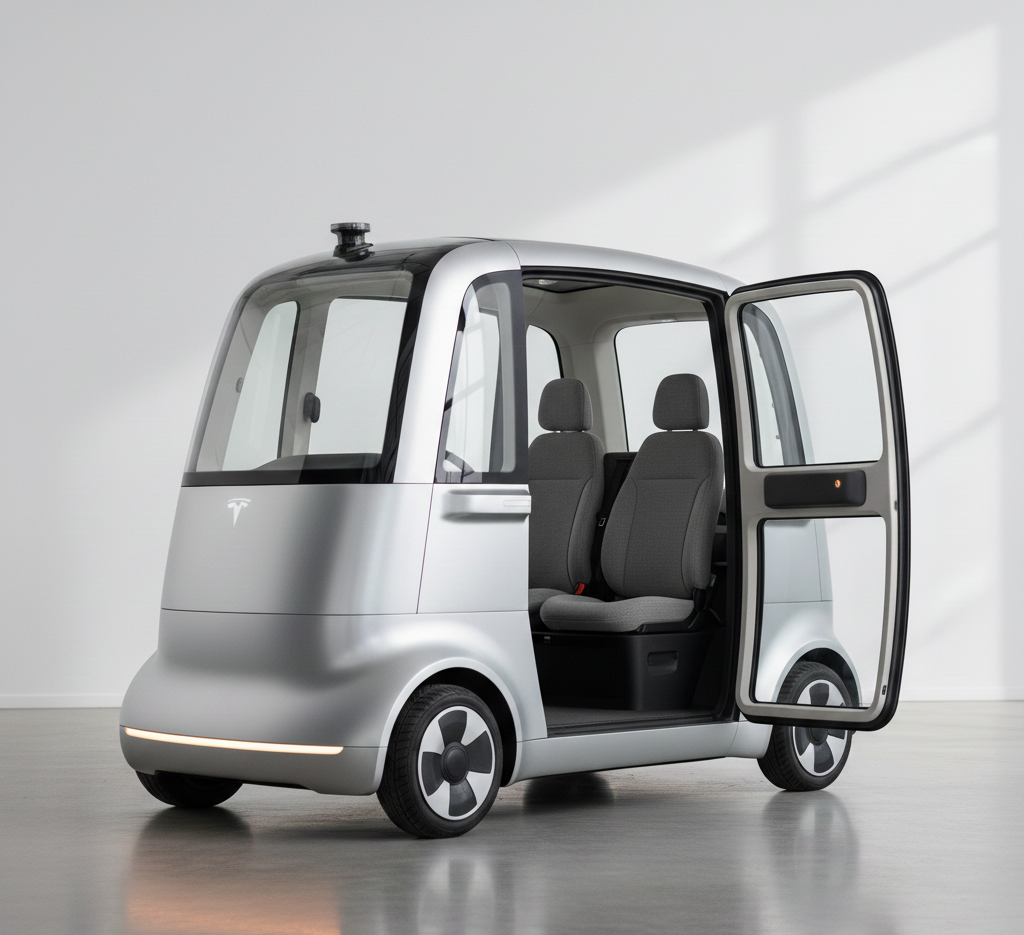
The April 2026 targeted launch for Cybercab production represents Tesla’s most controversial bet. Purpose-built autonomous vehicles without steering wheels or pedals require regulatory approval that remains uncertain. The “Unboxed” manufacturing method promises production speeds that traditional automotive assembly cannot match, but the approach remains unproven at volume. Technical specifications prioritize the unique requirements of autonomous operation over conventional vehicle priorities.
Unboxed manufacturing reimagines vehicle assembly by constructing major subassemblies independently before final integration, reducing the linear production constraints of traditional assembly lines. This method enables parallelization that dramatically increases throughput while reducing factory footprint. However, it demands extraordinary precision in dimensional tolerances and introduces new quality control challenges. Tesla’s willingness to deploy this approach for Cybercab’s launch demonstrates either supreme confidence or willingness to iterate through production problems in real-time.
Technical redundancies throughout Cybercab’s design reflect the reliability standards autonomous operation demands. Physical NACS charging ports backup the primary wireless charging system, ensuring vehicles can recharge even if wireless infrastructure fails. New rear-camera washer systems address the sensor degradation that rain, snow, and road spray cause, a critical reliability consideration given that autonomous systems cannot simply “pull over and wait” like human drivers might. These redundancies add cost and complexity but represent necessary insurance against the single-point failures that would strand autonomous fleets.
Legislative hurdles may prove more challenging than technical obstacles. The U.S. SELF DRIVE Act would provide the federal framework necessary for nationwide Cybercab deployment, preempting the patchwork of state regulations that currently constrains autonomous vehicle operations. European Article 39 exemptions serve similar functions in EU markets, allowing limited deployment of vehicles that don’t meet conventional safety standards designed around human drivers. Without these regulatory victories, Cybercab remains an impressive technology demonstration rather than a scalable business. Tesla’s political capital and lobbying efforts are being deployed as aggressively as their engineering resources.
Economic Drivers and Energy Growth
Financial analysts project Tesla’s share price reaching between $397 and $461 by year-end 2026, contingent on the company stabilizing automotive margins while demonstrating progress on autonomous and robotics programs. These projections reflect the market’s struggle to value Tesla—is it a car company with impressive technology, or a technology platform that happens to manufacture vehicles? The valuation gap between these interpretations creates the volatility that has characterized Tesla’s stock for years.
Margin stabilization requires navigating competing pressures. Price reductions stimulate demand but compress profitability. Raw material costs for batteries and critical minerals fluctuate with commodity markets and geopolitical tensions. Production efficiency improvements from manufacturing innovations offset some cost pressures but require capital investment. The financial performance ultimately depends on Tesla’s ability to grow revenue faster than costs increase, a challenge as the company scales into markets with different competitive dynamics than their initial luxury EV positioning.
Energy storage represents Tesla’s fastest-growing business segment, with Megapack and Megablock production scaling to meet grid-level demand that far exceeds initial projections. Utility-scale batteries enable renewable energy integration by storing solar and wind generation for discharge during peak demand periods. The total addressable market measures in the hundreds of gigawatt-hours annually as electrical grids worldwide transition away from fossil fuel generation. Tesla’s early positioning and integrated approach—combining battery cells, power electronics, and software controls—creates advantages in a market where competitors often assemble components from multiple suppliers.
Critical mineral security remains a strategic vulnerability that could constrain Tesla’s growth across all business segments. The 2026 lithium strategy relies heavily on key mines including Greenbushes in Australia and Salar de Atacama in Chile. These sources provide the raw materials for battery production that underpins vehicles, energy storage, and the charging infrastructure supporting autonomous operations. Supply disruptions, whether from geopolitical events, environmental challenges, or simple production shortfalls, would cascade through Tesla’s entire operation. The company’s investments in refining capacity and direct mining partnerships represent attempts to control more of the supply chain, but complete independence from global commodity markets remains impossible.
Strategic Infrastructure Projects
Giga Nevada’s production expansion faces an unexpected bottleneck—Interstate 80 congestion that limits employee access and supply chain logistics. Tesla’s exploration of tunneling solutions with The Boring Company represents the kind of vertical integration that critics mock until it solves problems competitors cannot address. Underground transportation links between Reno, the factory, and key residential areas could alleviate surface congestion while demonstrating Boring Company technology at commercial scale. This infrastructure investment only makes sense because Tesla controls both companies and can optimize solutions across their combined interests.
The logistics advantages extend beyond immediate congestion relief. Dedicated underground routes enable autonomous cargo transport immune to weather conditions and surface traffic patterns that disrupt conventional trucking. This creates a testing ground for the autonomous freight applications that represent another massive market opportunity. The tunnels themselves become infrastructure assets that appreciate rather than depreciate, potentially generating revenue from third-party users once Tesla’s needs are satisfied.
Global market performance, particularly in China, remains essential to Tesla’s volume targets and production efficiency. The Model Y and Model 3 continue dominating their segments in the world’s largest EV market despite intensifying competition from domestic manufacturers. Maintaining this position requires constant refinement of pricing, features, and local production capabilities. Gigafactory Shanghai’s efficiency and cost structure set benchmarks that other Tesla facilities work to match, creating a competitive advantage that extends beyond the Chinese market.
The Chinese success also demonstrates Tesla’s ability to navigate complex geopolitical environments where foreign automakers historically struggled. Relationships with local governments, supply chain partners, and consumers require cultural sensitivity and operational flexibility that many Western companies lack. This competence becomes increasingly valuable as geopolitical tensions between the U.S. and China complicate operations for companies attempting to serve both markets.
The Convergence Ahead
Tesla’s 2026 roadmap reveals a company attacking multiple frontiers simultaneously, betting that technological leverage and vertical integration create compounding returns that linear competitors cannot match. Custom silicon enables AI capabilities that power both autonomous vehicles and humanoid robots. Manufacturing innovations deployed in Cybercab production inform broader automotive strategies. Energy storage growth supports the charging infrastructure that autonomous fleets require while generating standalone revenue. Every initiative reinforces the others.
The execution risks are substantial. Regulatory approval for truly autonomous vehicles remains uncertain. Humanoid robotics faces technical challenges that have defeated well-funded competitors. Energy storage markets could saturate faster than projections suggest. Supply chain vulnerabilities for critical minerals could constrain growth across all segments. Any single setback could cascade into broader difficulties given how interconnected these initiatives have become.
Yet the potential rewards justify the risks. Success in autonomous vehicles creates a transportation-as-a-service business with margins that automotive manufacturing cannot approach. Optimus at scale addresses labor shortages while opening markets measuring in the trillions of dollars. Energy storage positions Tesla as essential infrastructure for the renewable energy transition that governments worldwide are mandating. The AI capabilities underlying all these applications represent intellectual property that compounds in value as deployment scales generate more training data.
Whether Tesla executes this vision successfully will define not just the company’s future but the competitive landscape across automotive, robotics, energy, and AI sectors. The companies that thrive in 2030 and beyond will be those that positioned correctly in 2026. Tesla is making bets that would terrify more conservative management teams. History will judge whether that audacity was visionary or reckless. Either way, the attempt is fascinating to witness.