Hashtags
Minnesota vs. Trump’s Operation Metro Surge: A Constitutional Collision Over Immigration Enforcement
The Trump Administration’s Operation Metro Surge represents one of the most aggressive federal immigration enforcement campaigns in American history, deploying thousands of Department of Homeland Security officers to conduct sweeps through communities where undocumented immigration rates fall below national averages—a strategic choice that reveals enforcement priorities extending beyond simple immigration law enforcement into the realm of political retaliation and ideological messaging. The operation’s targeting of Minnesota, a state whose Democratic leadership has embraced sanctuary policies and explicitly criticized federal immigration enforcement, transforms what the administration frames as routine law enforcement into a constitutional confrontation about federalism, state sovereignty, and the limits of executive power when wielded against politically disfavored jurisdictions.
The legal and political battle unfolding in Minnesota courts and communities carries implications far exceeding the immediate question of whether federal agents can conduct immigration enforcement in Minneapolis and Saint Paul. At stake are fundamental questions about whether federal executive authority includes the power to selectively deploy massive enforcement resources to punish states whose policies the administration opposes, whether federal operations can proceed without regard for state sovereignty and local community impact, and whether immigration enforcement can lawfully employ tactics—including fatal force, racial profiling, and disruption of essential community services—that would be unacceptable in virtually any other law enforcement context. The outcome will shape immigration enforcement nationwide, establishing precedents about federal power that will persist long after the current political moment passes.
Executive Summary of Operation Metro Surge as a Massive Federal Immigration Surge
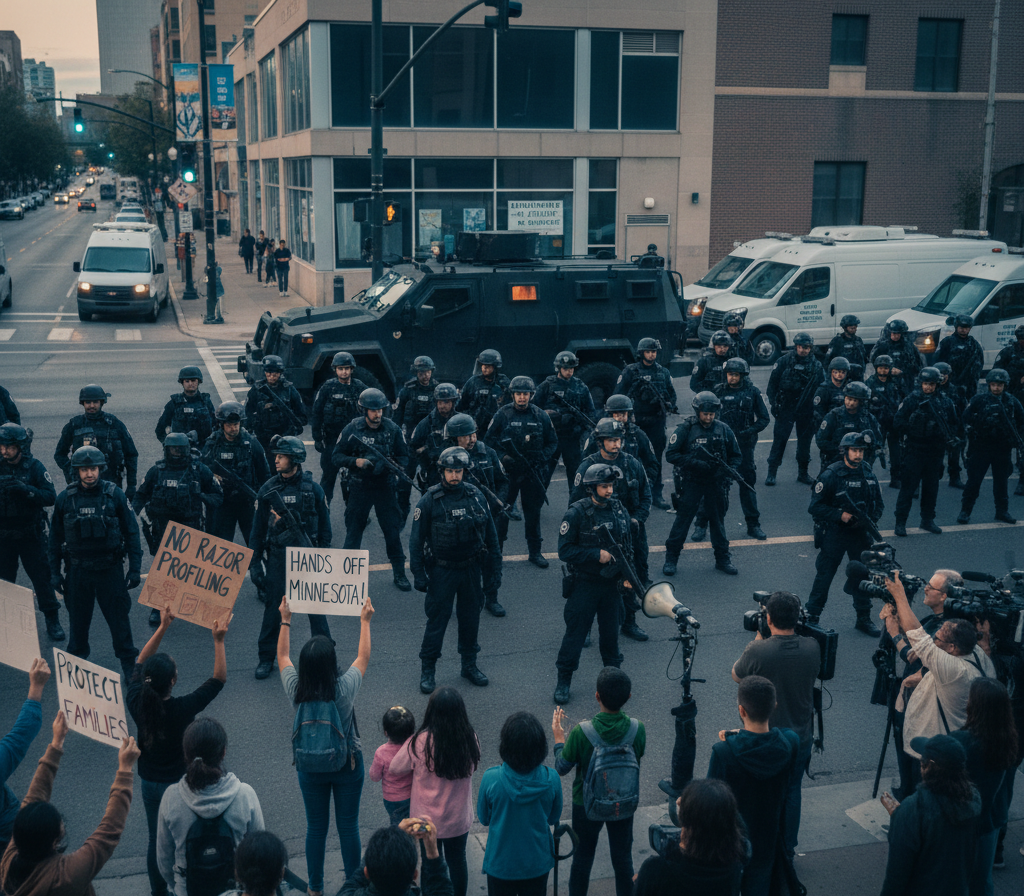
Operation Metro Surge mobilized approximately 2,000 DHS officers—including personnel from Immigration and Customs Enforcement (ICE), Customs and Border Protection (CBP), and various tactical units—for concentrated immigration enforcement operations throughout the Minneapolis-Saint Paul metropolitan area beginning in early 2026. The operation’s scale dwarfs typical immigration enforcement activities, representing a force deployment comparable to military operations rather than traditional law enforcement. The officers deployed include not just ICE enforcement agents conducting targeted arrests based on specific intelligence, but also Border Patrol tactical units, armed CBP officers typically stationed at ports of entry, and specialized teams whose training emphasizes confrontational tactics over community-oriented policing.
The administration justified this massive deployment through claims that Minnesota harbors significant numbers of immigration violators and that aggressive enforcement was necessary to combat what officials characterized as widespread immigration fraud and sanctuary policies that obstruct federal law enforcement. However, demographic data contradicts the premise that Minnesota faces unusual immigration enforcement challenges—the state’s undocumented population of approximately 95,000 represents just 1.7% of the total population, well below the national average of approximately 3.2%. This statistical reality raises obvious questions about why Minnesota warranted such disproportionate enforcement attention compared to states with substantially larger undocumented populations.
The legal conflict between the Trump Administration and Minnesota state officials crystallized when Minnesota Attorney General Keith Ellison filed federal lawsuits seeking injunctions to halt Operation Metro Surge, arguing that the operation violates constitutional principles of federalism, employs unlawfully discriminatory enforcement tactics, and was designed primarily as political retaliation against a state whose leadership opposes the administration’s immigration policies. The lawsuits frame the operation not as legitimate law enforcement but as an unconstitutional federal intrusion into state sovereignty, comparing the operation to the kind of federal overreach that conservatives typically condemn when directed toward states implementing policies that liberal administrations oppose.
The Strategic Deployment of Federal Forces
Analyzing the Dispatch of 2,000 DHS Officers to a Region with Lower-Than-Average Undocumented Populations
The decision to deploy 2,000 federal officers to Minnesota—a state with relatively low undocumented immigration compared to border states or major metropolitan areas with historically large immigrant populations—reveals that Operation Metro Surge prioritizes political messaging and punitive action against sanctuary jurisdictions over rational resource allocation based on immigration enforcement needs. Texas, California, Florida, New York, and Illinois all have substantially larger undocumented populations both in absolute numbers and as percentages of total population, yet none received comparable surge operations deploying thousands of federal agents for sustained enforcement campaigns.
This disproportionate deployment suggests that immigration enforcement has become instrumentalized as a tool for political discipline, with the administration directing massive resources toward punishing states whose leadership has criticized federal immigration policies or implemented sanctuary laws limiting state and local cooperation with federal immigration enforcement. The targeting reveals a troubling pattern where federal executive power serves partisan political objectives rather than neutral law enforcement priorities determined by objective assessment of where enforcement resources would most effectively advance immigration law compliance.
The inefficiency of deploying thousands of federal agents to areas with relatively small undocumented populations becomes apparent when examining arrest numbers relative to officer deployment. If the 2,000 officers collectively conducted 500 arrests over a month-long surge period—an aggressive enforcement pace—that represents just 0.25 arrests per officer, raising obvious questions about whether such massive deployments represent prudent resource allocation or whether the operation’s primary purpose involves intimidation and political theater rather than maximizing immigration law enforcement outcomes.
The Use of “Fraud” as a Policy Pretext Linked to the “Feeding Our Future” Case
The Trump Administration justified Minnesota’s targeting partly through allegations of immigration fraud connected to the “Feeding Our Future” case—a massive pandemic-era fraud scheme where individuals exploited federal child nutrition programs to steal over $250 million through fraudulent claims about meals served to children. Federal prosecutors charged numerous defendants in the case, with many having immigrant backgrounds or connections to Minnesota’s Somali community. The administration characterized this fraud case as evidence of broader immigration-related criminality warranting aggressive enforcement.
However, using a single fraud case—however massive—to justify targeting an entire state’s immigrant community for enforcement represents a logical leap that conflates immigration status with criminal conduct in ways that violate equal protection principles. The vast majority of Minnesota’s undocumented immigrants had no connection to Feeding Our Future fraud, yet the administration’s rhetoric implied that immigration fraud was pervasive throughout Minnesota’s immigrant communities, providing pretext for indiscriminate enforcement operations targeting immigrant neighborhoods regardless of whether residents had any connection to the fraud case that supposedly justified the surge.
This pretext appears particularly cynical given that Feeding Our Future fraud involved both immigrants and native-born Americans, targeted federal nutrition programs rather than immigration systems, and was already being prosecuted through normal federal criminal channels without any need for massive immigration enforcement operations. The administration’s linkage of immigration enforcement to the fraud case reveals how unrelated criminal conduct can be weaponized to justify immigration crackdowns that would otherwise appear discriminatory and politically motivated.
Human and Community Impacts
Chronology of Aggressive Tactics: The Fatal Shooting of Renee Good and Pepper-Spraying of Students/Attorneys
The human costs of Operation Metro Surge became tragically apparent when federal agents shot and killed Renee Good, a Minneapolis resident, during an enforcement operation. The circumstances surrounding the shooting remain disputed, with federal officials claiming agents faced threats justifying lethal force while witnesses and community advocates describe the shooting as an unjustified use of deadly force against someone who posed no genuine threat. The shooting galvanized opposition to the surge operation, transforming abstract legal arguments about federal overreach into concrete tragedy where a community member died during an immigration enforcement operation in a state where such aggressive tactics had previously been rare.
The fatal shooting of Renee Good represents the most extreme manifestation of Operation Metro Surge’s aggressive tactics, but numerous other incidents demonstrate a broader pattern of disproportionate force and disregard for community safety. Federal agents pepper-sprayed students at educational institutions during enforcement actions near schools, violating longstanding policies against immigration enforcement at sensitive locations like schools, hospitals, and places of worship. The pepper-spraying of students—many of whom were bystanders with no connection to enforcement targets—illustrates how surge operations prioritize achieving arrests over protecting community members who happen to be present when enforcement actions occur.
Federal agents also pepper-sprayed attorneys attempting to observe enforcement operations and document potential civil rights violations, raising serious concerns about obstruction of legal representation and First Amendment violations. Attorneys serve essential constitutional functions by monitoring law enforcement conduct, advising individuals of their rights, and ensuring that enforcement operations comply with legal standards. Using chemical weapons against attorneys performing these functions suggests that surge operations deliberately sought to avoid accountability by preventing legal observation and documentation of enforcement tactics.
Documentation of Racial Profiling Incidents Involving Citizens and Legal Residents
Operation Metro Surge generated numerous documented incidents where federal agents detained, questioned, or arrested U.S. citizens and legal permanent residents based apparently on racial or ethnic appearance rather than individualized evidence of immigration violations. These racial profiling incidents included federal agents stopping Latino, African, and Asian Americans in public spaces, demanding identification and immigration documentation despite individuals’ citizenship or legal status, and conducting pretextual stops where demands for immigration paperwork followed minor traffic violations or pedestrian encounters.
The racial profiling extended to workplaces and residences, with agents conducting raids where everyone of certain ethnic appearances was detained for immigration checks while white individuals at the same locations were ignored. These discriminatory enforcement patterns violate constitutional equal protection guarantees and federal regulations prohibiting racial profiling in law enforcement. The documented cases include citizens detained for hours despite presenting U.S. passports, legal residents arrested despite showing green cards, and DACA recipients taken into custody despite having work authorization and legal presence.
The psychological trauma and community fear generated by these racial profiling incidents extends far beyond individuals directly detained, creating climates where entire communities—including citizens and legal residents—avoid public spaces, skip work and school, and live in constant fear of encounters with federal agents who apparently cannot distinguish between undocumented immigrants and legal residents or citizens who happen to share ethnic backgrounds with immigrant communities.
Impact on Essential Services: School Lockdowns and Daycare Closures
The collateral damage from Operation Metro Surge included repeated school lockdowns when federal enforcement operations occurred near educational facilities, disrupting learning for thousands of students while creating traumatic experiences for children who witnessed armed federal agents conducting arrests in their neighborhoods. Schools implemented lockdown procedures designed for active shooter scenarios, keeping students confined to classrooms for hours while enforcement operations proceeded nearby. The psychological impact on children—particularly those from immigrant families who feared parents might be arrested—cannot be overstated.
Daycare centers throughout immigrant-heavy neighborhoods closed either temporarily during surge operations or permanently after attendance collapsed when parents kept children home rather than risking encounters with federal agents during dropoff or pickup. These closures created cascading economic impacts as parents—including many who are citizens or legal residents—could not work without childcare, reducing household incomes while businesses lost employees. The daycare closures disproportionately affected working mothers, many of whom had no alternative childcare options when neighborhood centers shut down.
Economic Fallout and Local Governance
Quantifying the Loss of Customer Traffic and Tax Revenue in Immigrant-Serving Business Corridors
Economic impacts from Operation Metro Surge devastated business corridors serving immigrant communities, with restaurants, retail shops, and service businesses reporting customer traffic declines of 50-80% as community members avoided public spaces where federal enforcement operations occurred. The economic devastation extended beyond businesses directly serving undocumented immigrants to include establishments whose customer bases include legal residents and citizens from immigrant communities who altered behaviors to avoid potential encounters with federal agents.
Sales tax revenue for Minneapolis and Saint Paul declined measurably in immigrant-heavy neighborhoods, reducing municipal budgets and forcing potential service cuts in communities already struggling with the disruptions caused by federal enforcement operations. Small businesses, many owned by immigrants or serving immigrant communities, faced potential bankruptcy as weekly revenues proved insufficient to cover rent, utilities, and payroll. Several businesses closed permanently, representing lost investments and employment for communities that can least afford economic disruption.
The long-term economic damage extends beyond the immediate period of surge operations, as businesses that survive may never fully recover customer traffic if immigrant communities permanently alter shopping and dining patterns based on fears of federal enforcement. The economic fallout also affects property values in immigrant neighborhoods, creating potential declines in housing wealth that disproportionately harm working-class homeowners who depend on home equity as primary financial assets.
The Burden on Minneapolis and Saint Paul Police Departments
Operation Metro Surge imposed enormous burdens on Minneapolis and Saint Paul police departments, which faced demands to provide support for federal operations while managing community protests, responding to increased emergency calls from frightened residents, and attempting to maintain public safety in neighborhoods where federal enforcement operations created chaos. The police departments incurred massive overtime costs as officers worked extended shifts responding to surge-related incidents, with preliminary estimates suggesting millions in unbudgeted overtime expenses that strain municipal finances.
More damaging than financial costs, Operation Metro Surge eroded years of community policing efforts aimed at building trust between law enforcement and immigrant communities. Minneapolis and Saint Paul police had invested substantial resources in community engagement programs encouraging immigrants to report crimes, cooperate with investigations, and trust police as community partners rather than threats. The federal surge operations destroyed this trust virtually overnight, as immigrants could not distinguish between local police engaged in community policing and federal agents conducting immigration enforcement, leading to complete withdrawal of immigrant cooperation with local law enforcement.
The erosion of community trust creates long-term public safety risks as immigrant communities become unwilling to report crimes, serve as witnesses, or cooperate with police investigations for fear that any law enforcement contact could lead to immigration consequences. This creates environments where crime can flourish because perpetrators know victims won’t report offenses and witnesses won’t cooperate with investigations, ultimately making everyone—regardless of immigration status—less safe.
Constitutional and Statutory Violations
The Tenth Amendment Argument: Federal Agents Infringing on State’s Inviolable Sovereign Authority
Minnesota’s legal challenge to Operation Metro Surge centers partly on Tenth Amendment principles reserving powers not delegated to the federal government to the states, arguing that the surge operation violates state sovereignty by commandeering state resources, disrupting state institutions, and conducting operations in ways that undermine state policies enacted through democratic processes. The Tenth Amendment argument doesn’t claim that immigration enforcement itself exceeds federal authority—immigration regulation is clearly a federal power—but rather that the manner and scale of Operation Metro Surge violates principles of federalism by treating Minnesota as occupied territory subject to federal control rather than a sovereign state entitled to deference regarding operations within its borders.
The argument emphasizes that federal immigration enforcement, while constitutionally legitimate, must be conducted in ways that respect state sovereignty and don’t commandeer state resources or officials to implement federal policies. Operation Metro Surge violated these principles by effectively requiring state and local resources to support federal operations through police department involvement, emergency services mobilization, and disruption of state institutions like schools that were forced to implement emergency protocols during federal enforcement actions.
Retaliation Claims: Allegations That the Surge Targets “Sanctuary” Jurisdictions for Political Reasons
Minnesota’s lawsuit alleges that Operation Metro Surge represents unconstitutional retaliation against a state whose leadership implemented sanctuary policies and criticized federal immigration enforcement, violating First Amendment principles protecting states’ rights to adopt policies reflecting their residents’ values and to criticize federal actions without facing punitive federal responses. The retaliation claim draws on evidence including statements from Trump Administration officials criticizing Minnesota’s sanctuary policies, the disproportionate deployment of enforcement resources compared to states with larger undocumented populations but more cooperative political leadership, and the timing of operations following public criticisms of federal immigration policies by Minnesota officials.
Retaliation claims require showing that federal actions were motivated by desire to punish protected speech or policy choices rather than legitimate enforcement objectives. Minnesota argues that Operation Metro Surge’s scale, targeting, and tactics can only be explained as punishment for sanctuary policies rather than as rational enforcement strategy, particularly given Minnesota’s below-average undocumented population and lack of border enforcement challenges that might justify massive federal deployment.
Administrative Procedure Act (APA) Violations: Arbitrary Revocation of Sensitive Locations Policies
The lawsuit challenges Operation Metro Surge’s violations of sensitive locations policies that previously limited immigration enforcement at schools, hospitals, places of worship, and other locations where enforcement would undermine essential community functions or create particular hardships. These policies, developed under previous administrations, recognized that immigration enforcement objectives must sometimes yield to other important interests like educational access, healthcare utilization, and religious freedom. The Trump Administration’s arbitrary revocation of these policies without proper notice-and-comment rulemaking violates the Administrative Procedure Act’s requirements for reasoned decision-making and public participation in policy changes.
The APA violations extend beyond procedural failures to substantive arbitrariness, as the administration provided no reasoned explanation for why sensitive locations policies should be eliminated or how immigration enforcement benefits from conducting operations at schools and hospitals outweigh the substantial harms to educational access and healthcare utilization that result when immigrant communities avoid these essential institutions for fear of encountering federal agents.
Conclusion and Legal Objectives
The Demand for Declaratory and Injunctive Relief to Halt the Surge
Minnesota’s lawsuit seeks declaratory judgment that Operation Metro Surge violates constitutional principles of federalism, equal protection, and First Amendment retaliation protections, along with injunctive relief immediately halting surge operations pending full litigation of the merits. The injunction request emphasizes irreparable harms including loss of life, community trauma, economic devastation, and erosion of community-law enforcement trust that cannot be remedied through money damages if Minnesota ultimately prevails on the merits.
The legal theory supporting injunctive relief argues that continuing surge operations while litigation proceeds inflicts harms so severe that maintaining the status quo—which would mean halting the surge—is necessary to preserve Minnesota’s ability to obtain meaningful relief if courts ultimately rule in the state’s favor. The administration opposes injunctive relief by claiming that halting immigration enforcement would harm public safety, but Minnesota counters that the surge’s tactics actually undermine public safety by destroying community trust in law enforcement while providing minimal immigration enforcement benefits given Minnesota’s small undocumented population.
Proposed Requirements for Federal Agents: Visible Identification and Body-Worn Cameras
Beyond seeking to halt Operation Metro Surge entirely, Minnesota’s lawsuit requests that if enforcement operations continue, federal agents must comply with basic accountability measures including visible identification displaying names and badge numbers, and mandatory body-worn cameras recording all enforcement interactions. These requirements—standard in professional law enforcement—would provide accountability for federal operations that currently occur with minimal oversight or documentation.
The visible identification requirement addresses incidents where federal agents refused to identify themselves or displayed only generic badges without individual identifying information, making it impossible to file complaints or identify officers for potential disciplinary action or testimony. Body-worn camera requirements would create objective records of enforcement encounters, protecting both community members from unlawful conduct and federal agents from false accusations while providing evidence for subsequent legal proceedings addressing whether operations complied with constitutional and statutory requirements.
The Trump Administration opposes these accountability measures by claiming they would compromise operational security and officer safety, but Minnesota counters that local police departments operate safely while wearing visible identification and body cameras, and that federal agents deserve no special exemption from accountability standards that apply to other law enforcement. The outcome of this relatively modest request for basic accountability measures may indicate whether courts will impose any meaningful oversight on federal immigration enforcement or allow operations to proceed without the transparency and accountability that democratic governance demands.