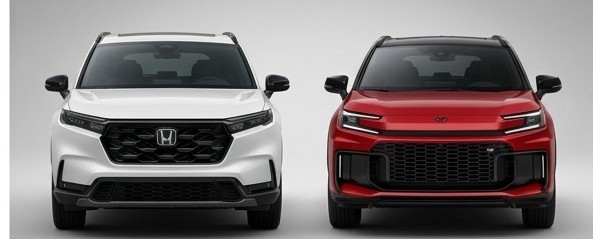
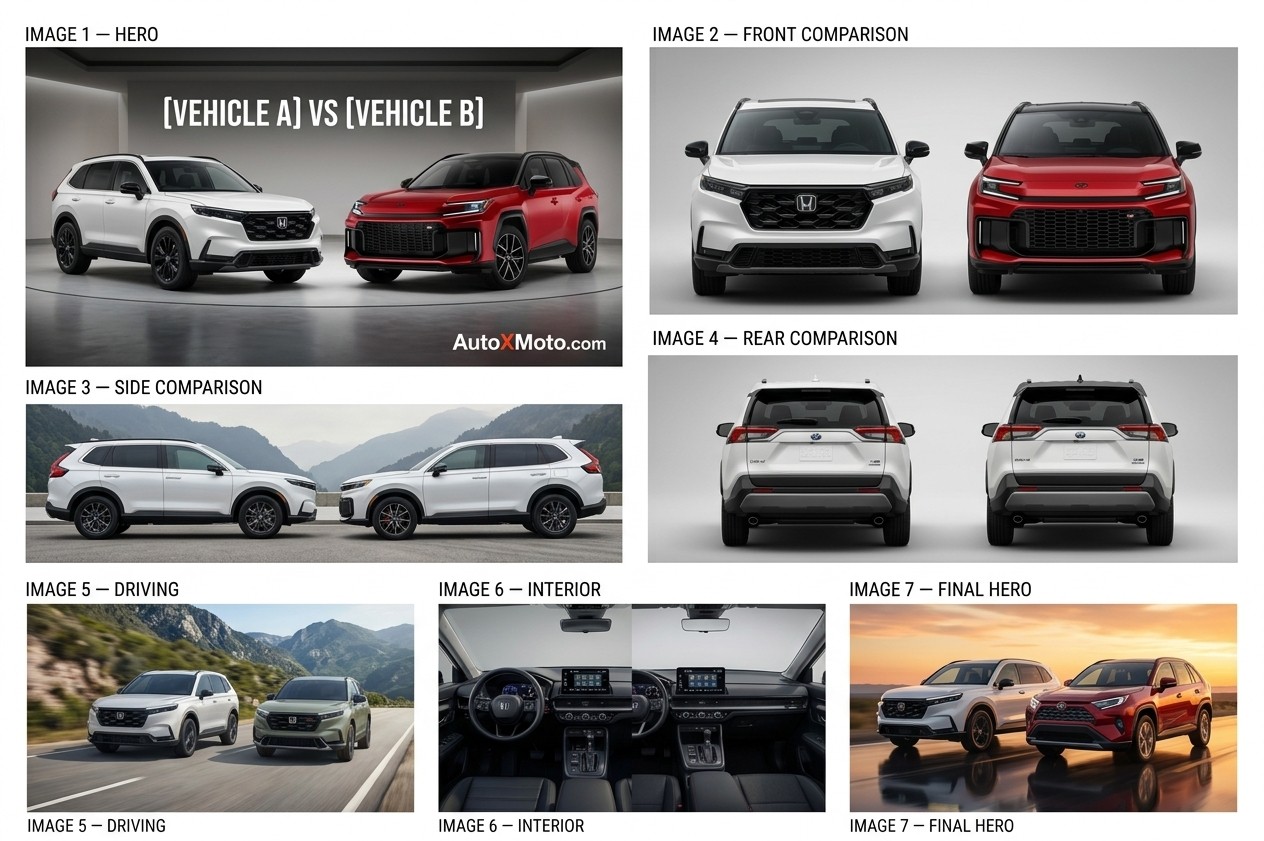
2026 Toyota RAV4 Hybrid vs. Honda CR-V Hybrid: The Ultimate Compact SUV Comparison
The compact SUV segment has quietly become a hybrid-versus-hybrid fight, and nowhere is that clearer than in the ongoing rivalry between Toyota’s RAV4 and Honda’s CR-V. Both nameplates move well over 400,000 units a year in the U.S., and in both cases, hybrid variants now account for more than half of that volume. The real shift for 2026, though, is that Toyota is going all-in: the sixth-generation RAV4 drops gas-only powertrains entirely, making this the first year the comparison is a pure hybrid-to-hybrid matchup. Broadly, the RAV4 leans into horsepower, efficiency, towing, and tech, while the CR-V leans into interior space and material quality. Here’s how that plays out in practice.
Powertrain, Horsepower, and Performance
Under the hood, the two take different engineering approaches. The RAV4 Hybrid runs Toyota’s fifth-generation hybrid system, pairing a 2.5-liter four-cylinder with a lithium-ion battery pack. The CR-V Hybrid uses a 2.0-liter direct-injection Atkinson-cycle four-cylinder alongside a two-motor electric setup. On paper, Toyota comes out ahead on output — 226 combined horsepower in front-wheel-drive trims and 236 in all-wheel-drive configurations, compared to a flat 204 horsepower across every CR-V Hybrid trim.
The AWD systems themselves work differently, too. Toyota’s Electronic AWD uses a dedicated rear electric motor, which delivers power to the rear axle without a mechanical connection to the front. Honda’s Real Time AWD sticks with a traditional mechanical driveshaft setup. Neither approach is inherently superior — it’s more a question of which failure modes and maintenance profile you’d rather live with.
Real-World Efficiency: EPA Fuel Economy
Fuel economy is where the RAV4 pulls a clear and consistent lead. In front-wheel-drive trims, the RAV4 Hybrid LE and SE are EPA-rated at 47 mpg city, 40 highway, and 43 combined, versus 43/36/40 for the CR-V Sport FWD. The gap narrows slightly in all-wheel-drive form — the RAV4’s base AWD trims come in at 46/40/42, with the rugged Woodland trim dropping to 41/36/38, while the CR-V Hybrid AWD sits at 40/34/37, and its TrailSport variant lands at 38/33/35. Across every comparable trim pairing, Toyota holds a meaningful mpg advantage, which adds up over years of ownership even before you factor in fuel prices.
Practical Utility: Towing and Cargo
If towing matters to you, this comparison isn’t close. The RAV4 Hybrid can tow up to 3,500 pounds when properly equipped, while the CR-V Hybrid tops out at just 1,000 pounds — and in some North American configurations, it isn’t rated for towing at all. That’s a real limitation for anyone who wants to haul a small trailer, boat, or camper occasionally.
Cargo space tells a more nuanced story. With the rear seats up, the RAV4 actually holds slightly more — 37.8 cubic feet versus the CR-V’s 36.3. But fold the seats down, and the CR-V takes the lead, offering 71.8 to 76.5 cubic feet depending on trim, compared to the RAV4’s 69.8 to 70.4. The CR-V also has a wider cargo floor (47 inches versus 44) and sits lower to the ground for easier loading. Passenger space follows a similar split: the CR-V offers noticeably more rear legroom at 41.0 inches versus the RAV4’s 37.8, while the RAV4 counters with more rear headroom, 39.5 inches to the CR-V’s 38.2. In short, the RAV4 wins on hauling gear behind a trailer hitch; the CR-V wins on hauling people and cargo inside the cabin.
Cabin Technology, Infotainment, and Safety
Toyota is making a real technology push this generation with its new Arene software platform, debuting on the RAV4 with multi-pane display support, 5G connectivity, and over-the-air update capability. Screen sizes reflect that priority: a standard 10.5-inch touchscreen with a 12.9-inch option, a standard 12.3-inch fully digital instrument cluster, and even a factory-integrated dashcam that records both front and rear footage as standard equipment.
Honda’s answer is Google Built-In, bringing native Google Maps and Assistant integration — but it’s restricted to the top Sport Touring trim, which starts at $44,500. Lower CR-V trims make do with a smaller 9.0-inch touchscreen and either a 7.0-inch or 10.2-inch instrument display, depending on trim level. Both brands equip their full lineups with capable driver-assist suites — Toyota Safety Sense 4.0 includes pre-collision braking with pedestrian detection, radar cruise control, lane tracing assist, and emergency steering assist, while Honda Sensing covers adaptive cruise, collision mitigation, and lane-keeping assist as standard across every trim. Feature-for-feature, though, Toyota’s suite reads as slightly more comprehensive at this model year.
Ownership Costs, Pricing, and Warranty
Toyota also undercuts Honda on price. The RAV4 Hybrid LE FWD starts at $33,350 delivered, versus $37,080 for the CR-V Sport Hybrid FWD — nearly a $3,700 gap at the entry point. Move up to more comparably equipped trims and the gap persists: an RAV4 SE at $36,150 lines up closely with the CR-V Sport while still saving about $930.
Resale value follows the same trend. Toyota’s RAV4 depreciates roughly 30.3% over five years, retaining just under 70% of its original value, while the CR-V depreciates around 34.5%, retaining about 65.5%. Warranty coverage on the hybrid battery favors Toyota as well — 10 years or 150,000 miles, compared to Honda’s 8 years or 100,000 miles. Across nearly every ownership-cost metric, the RAV4 comes out ahead.
Driving Dynamics and Interior Refinement
This is where the CR-V claws back some ground. Honda’s setup leans more heavily on electric propulsion during acceleration, which produces a smoother, quieter driving experience without the engine drone that can creep into hybrid powertrains under load. The RAV4, by comparison, can exhibit some “motor-boating” — an engine flare sensation — under harder acceleration, a known characteristic of Toyota’s hybrid CVT tuning. Interior materials tell a similar story: the CR-V uses higher-grade soft-touch surfaces throughout, while the RAV4 relies on more durable but less premium-feeling hard plastics, particularly on lower trims.
Final Verdict: Which One Should You Buy?
Choose the RAV4 Hybrid if you want the best fuel economy in the segment, meaningfully stronger towing capability, the most advanced cabin technology on offer, and better long-term value through lower pricing, stronger resale, and a longer battery warranty.
Choose the CR-V Hybrid if rear-seat comfort and total cargo capacity with the seats folded matter more to your daily life, if you value a quieter and more refined acceleration feel over raw efficiency numbers, and if cabin material quality is a priority you’re willing to pay a premium for.
Neither SUV makes a wrong choice here — it genuinely comes down to whether you’re optimizing for efficiency and capability, or for comfort and refinement.