The Tesla Cybercab: Inside the Hardware Betting Everything on Unsupervised Autonomy
Introduction
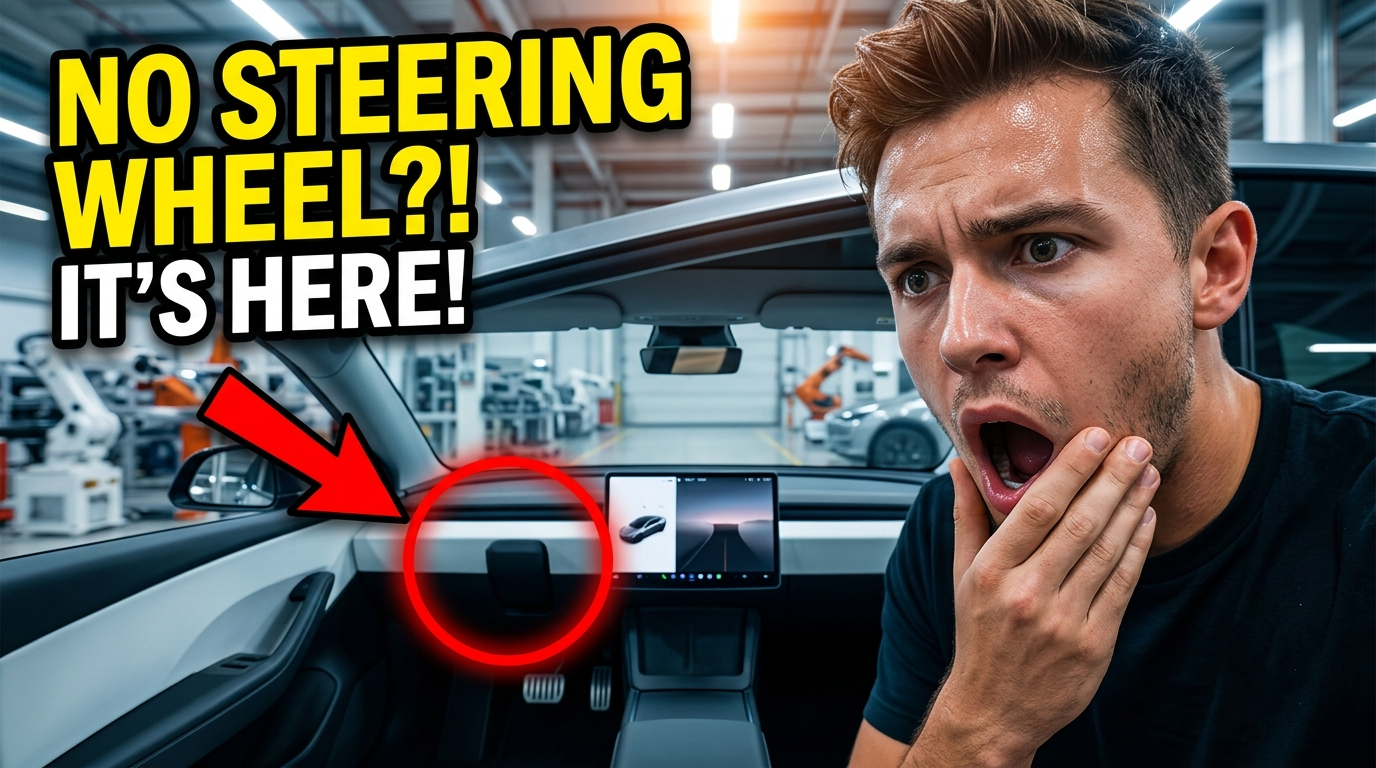
The Cybercab is the clearest physical evidence yet that Tesla considers itself something other than a car company. Every design choice — no steering wheel, no pedals, no side mirrors — signals a bet that Tesla’s future runs through AI and robotics rather than traditional vehicle sales. Production began at Giga Texas in April 2026, and the vehicle has since cleared EPA certification, putting real engineering numbers behind years of stage-show promises.
The Cybercab Technical Deep-Dive
EPA filings published in June 2026 finally revealed the Cybercab’s hard numbers, and a few of them surprised engineers. The vehicle weighs 3,113 lbs curb weight — lighter than a Model 3 by roughly 700 lbs, but heavier than expected for a stripped-down two-seat commuter pod, likely due to the crash structure needed around a steerless front zone. A single 163 kW (219 HP) front-mounted permanent magnet motor drives the front wheels, paired with a compact 48 kWh battery pack running at 326 volts — small by modern EV standards, but paired with the vehicle’s light weight to deliver a lab-tested range north of 400 miles, translating to a more realistic real-world estimate closer to 290-300 miles.
Charging is where Tesla is taking its biggest infrastructure swing. The company secured an FCC waiver in February 2026 to use Ultra-Wideband radio technology in fixed outdoor equipment — technically restricted to handheld devices — clearing the path for a wireless inductive charging system where the Cybercab parks itself over a ground-embedded pad with millimeter-level precision. It’s a genuinely necessary piece of infrastructure for a car with no steering wheel: without wireless charging, someone still has to physically plug it in. Current validation units still use a conventional NACS port as a backup while the wireless system matures.
Sensor resilience matters enormously here too, since the Cybercab runs entirely on cameras with no lidar or radar. Every external camera is paired with a high-pressure washer nozzle to keep lenses clear in rain or mud, since there’s no human driver available to wipe a dirty lens mid-ride. Recent prototypes have also shown noticeably larger front camera clusters, suggesting an upgraded optical package tied to Tesla’s next-generation AI hardware.
Manufacturing Breakthroughs and Regulatory Readiness
Tesla’s “unboxed” manufacturing process, first detailed at its 2025 shareholder meeting, ditches the traditional single conveyor line in favor of parallel sub-assembly stations that merge late in the build — a method Tesla says could eventually let a finished Cybercab roll off the line roughly every ten seconds.
On the regulatory side, Texas became the proving ground almost by necessity. A new state law took effect in late May 2026 requiring autonomous vehicle operators to register their fleets with the Texas Department of Motor Vehicles, adding real oversight to a previously permit-light environment. But the registry also exposed an uncomfortable truth for Tesla: as of the May 2026 filings, Tesla had registered just 42 autonomous vehicles for driverless ridehailing in the state — less than a tenth the size of Waymo’s 577-vehicle registered fleet, and smaller even than competitors like Avride.
As for the “economic moat” argument, it holds up on hardware cost alone: a full lidar sensor suite still runs roughly $12,000 per vehicle industry-wide, against a few hundred dollars for a camera-only setup, and Morgan Stanley has pegged Tesla’s current robotaxi cost per mile at around $0.81 versus $1.36-$1.43 for Waymo. Whether that hardware cost advantage translates into a durable business moat is a separate question — one that depends entirely on unsupervised FSD matching lidar-based safety outcomes at scale, which hasn’t yet been independently demonstrated.
Master Plan Part IV: The Vision of Sustainable Abundance
Tesla’s latest strategic document, unveiled in 2025, reframes the company’s mission from “sustainable energy” to “sustainable abundance” — an explicit pivot toward using one shared AI and manufacturing stack across FSD, Robotaxis, and the Optimus humanoid robot. The logic connects all three: vehicles generate the driving data that trains Tesla’s neural networks, that same AI stack teaches Optimus to perform physical labor, and both together are meant to fund an eventual global fleet of autonomous, revenue-generating machines. It’s a genuinely different framing than Tesla’s earlier “master plans,” which stayed centered on transportation and energy rather than labor and robotics broadly.
The $8.5 Trillion Incentive: The 2025 CEO Performance Award
Shareholders approved Elon Musk’s new compensation package in November 2025, and its scale is almost impossible to overstate. The award is structured across 12 tranches: the first requires Tesla to reach a $2 trillion market cap, the next nine each require an additional $500 billion (up to $6.5 trillion), and the final two require $1 trillion increments each, capping at an $8.5 trillion valuation — roughly five times Tesla’s market cap at the time of approval.
Each market-cap tranche must be paired with an operational milestone, including 20 million cumulative vehicles delivered, 10 million active FSD subscriptions, 1 million Optimus bots delivered, 1 million robotaxis in commercial operation, and a series of adjusted EBITDA targets. The board has defended the package as necessary to keep Musk focused on Tesla specifically, arguing that the milestones are demanding enough that he “gets nothing unless he creates significant value” for shareholders — though critics, including some proxy advisory firms, have flagged the unusual scale of voting-power concentration the full package would hand him.
Competitive Analysis and Future Outlook
The Waymo-Tesla rivalry has become the defining storyline in autonomous vehicles, and by mid-2026 the picture is genuinely mixed rather than settled in Tesla’s favor. Waymo runs roughly 3,000 vehicles across eleven US metro areas, delivering close to half a million paid rides weekly, backed by outside safety validation — a Swiss Re study found meaningfully fewer injury and property-damage claims than human drivers across tens of millions of miles. Tesla’s fleet remains a small fraction of that size, and its Austin operation is under an active NHTSA investigation following a string of reported incidents. Tesla’s argument is that software scales faster than hardware — you can retrain a neural network overnight, but you can’t retrofit lidar onto millions of existing cars — and that camera-only costs will eventually make its fleet dramatically cheaper to deploy per mile. Whether that bet pays off depends entirely on whether vision-only driving can match lidar-based safety at real scale, which remains the central unresolved question in the entire robotaxi race.
The Cybercab represents genuinely novel hardware: purpose-built, camera-only, wirelessly chargeable, and manufactured through a process Tesla believes can undercut every competitor on cost. But hardware readiness and software readiness are two different problems, and only one of them is solved. Until unsupervised FSD proves it can match validated safety records at meaningful scale, the promise of driverless mobility by 2026 remains a production milestone achieved on the assembly line, not yet a commercial reality on the road.