Hashtags
Ask ten different luxury car owners which German brand is “the best,” and you’ll get ten different answers — and all ten will be right, depending on what they actually value. BMW, Mercedes-Benz, and Audi have spent decades building three distinct personalities, and the “winner” really comes down to what you’re optimizing for.
Introduction to the German Big Three
Each brand has a genuine, identifiable DNA. BMW built its identity on “the ultimate driving machine” — rear-wheel-drive dynamics, sharper steering, and a sportier cabin feel. Mercedes leans into old-world prestige: cushioned ride quality, a calmer driving character, and interiors that prioritize occasion over aggression. Audi splits the difference with a tech-forward, minimalist approach and all-weather Quattro confidence that’s made it the default choice for buyers in snowier climates.
Before comparing spec sheets, it helps to name your actual priority. Someone chasing corner-carving feedback wants a different car than someone who wants to arrive at a boardroom looking unruffled, and both want something different from the buyer who just wants the newest screen in the segment.
Flagship Sedan Comparison (7 Series, S-Class, A8)
The flagship sedans are where each brand’s philosophy is most exaggerated. The BMW 7 Series goes for a more expressive cabin — lots of ambient lighting, a genuinely showy design language, and available rear-seat theater screens paired with reclining “Ultimate Pack” seats that turn the back row into a private lounge. Mercedes’ S-Class takes a quieter, more restrained route: black lacquer and bright chrome accents instead of flash, with a removable rear tablet that controls climate, seating, and entertainment rather than a fixed screen.
Behind the wheel, the difference is just as pronounced. The S-Class has what owners often describe as a “chill” factor — it isolates road imperfections and encourages a relaxed driving posture. The 7 Series, even in its most luxurious trims, holds onto more of BMW’s sport-mode responsiveness, rewarding a driver who occasionally wants to push it rather than float above the road.
Technical Mastery: All-Wheel Drive Systems Compared
Under the skin, the three brands solve all-wheel drive very differently. Audi’s Quattro system is built around a mechanical Torsen center differential that distributes torque instantly between axles without waiting for wheel slip — the closest thing to “set it and forget it” grip in the segment. Audi also offers a Quattro Ultra variant that decouples the rear axle in low-demand situations to save fuel, only re-engaging when sensors detect the front wheels are about to lose traction.
BMW’s xDrive, by contrast, is built around the brand’s traditional transverse-mounted engine layout tuned for stability and efficiency rather than mechanical grip alone — it defaults to a rear-biased torque split to preserve that sporty character, then shifts power forward electronically as conditions demand.
Mercedes’ 4MATIC system aims for a middle ground: German engineering discipline applied across both transverse (compact-car) and longitudinal (sedan and SUV) platforms, with software constantly rebalancing torque to favor comfort and predictability over outright cornering aggression.
Reliability and Maintenance: The Ownership Reality
This is where brand mythology and real-world data start to diverge. In the 2025 J.D. Power U.S. Vehicle Dependability Study, which tracks three-year-old vehicles, BMW owners reported 189 problems per 100 vehicles, Mercedes-Benz owners reported 243, and Audi owners reported 273 — a meaningfully wide spread among brands that command similar prices. J.D. Power’s data also flagged a broader “new model penalty”: newly launched or redesigned vehicles across the industry averaged 241 problems per 100 vehicles, compared with 196 for carryover designs, meaning a brand-new redesign — regardless of badge — statistically carries more early-ownership risk than a car that’s been in production a few years.
On upkeep, Audi and Mercedes tend to run neck-and-neck for routine service costs, with interim (minor) services typically covering oil, filters, and inspection points, and full services adding brake fluid, spark plugs, and more comprehensive diagnostics — both noticeably pricier than mainstream brands, and both climbing further once a vehicle exits its factory warranty.
If you’re buying used or keeping a car long-term, a few habits meaningfully lower the pain: use independent specialists certified specifically on the brand rather than a general import shop, stick rigidly to the manufacturer’s service intervals rather than stretching them, and favor well-reviewed model years over first-year redesigns whenever possible.
The Future is Electric: i7 vs. EQS
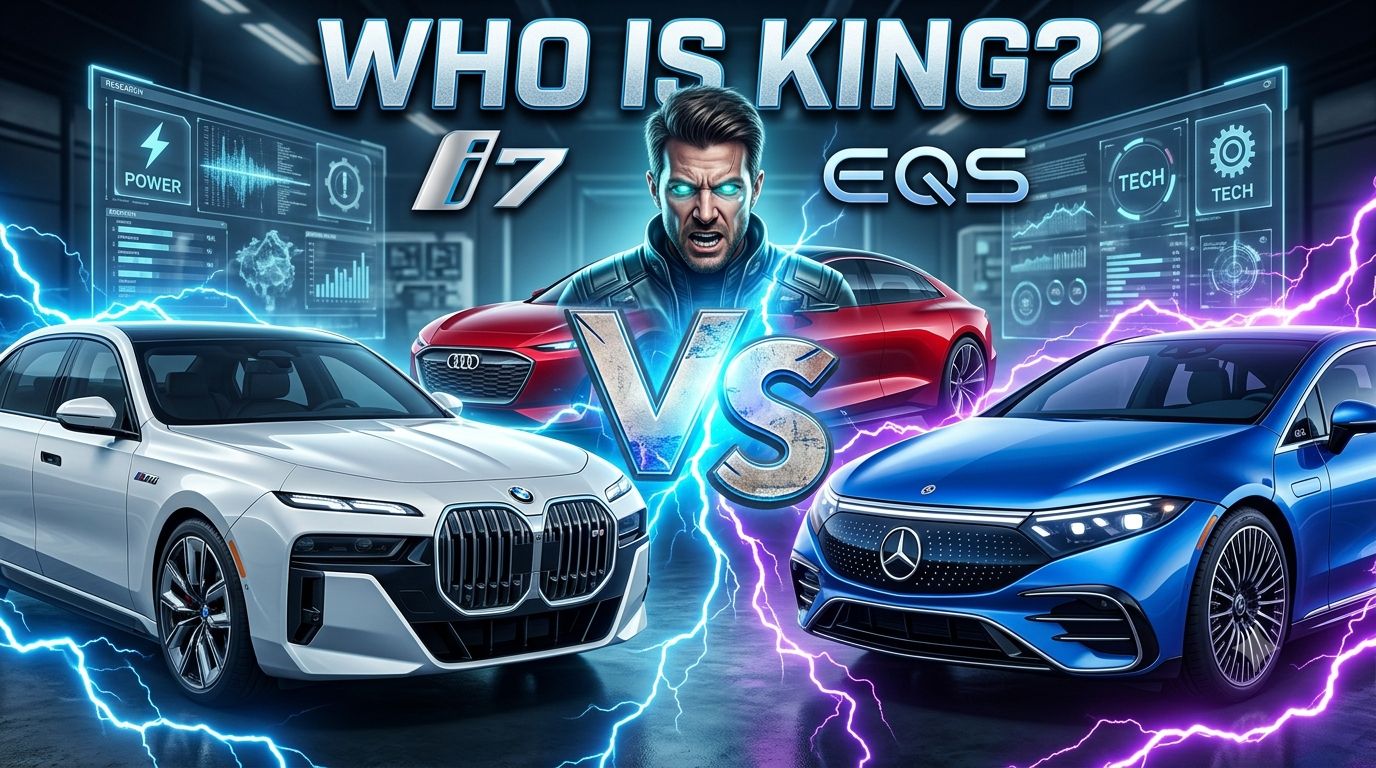
BMW and Mercedes took different architectural bets on electrification. Mercedes built the EQS on a dedicated EV-only platform, optimized from the ground up for battery packaging and aerodynamics. BMW’s current i7 instead uses a flexible architecture shared with combustion 7 Series models — a strategy BMW is now moving away from with its new Neue Klasse platform, a ground-up EV architecture debuting first in the iX3 and expected to underpin a Neue Klasse sedan.
Software is the other battleground. Buyers increasingly weigh native Google services integration against a brand’s proprietary navigation and voice systems — a decision that affects everything from map accuracy to how well the car talks to a smartphone ecosystem, and one where preferences are often more personal than either brand would like to admit.

Business Stability and Market Risks
None of these brands are immune to the broader shifts reshaping the auto industry. China — long the most profitable market for all three — has turned sharply more competitive as domestic EV brands gain share; Mercedes, BMW, and other legacy automakers posted steep year-over-year sales declines there in recent quarters as local competitors expanded aggressively. That pressure is pushing all three brands to accelerate cost discipline and rethink model lineups.
BMW’s timing on Neue Klasse looks increasingly strategic in this context — launching a dedicated EV platform just as competitive and regulatory pressure intensifies gives it a newer architecture to lean on, even as the broader German luxury segment absorbs a difficult stretch in its largest overseas market.
Final Verdict: Which One Should You Buy?
The case for BMW: if engaging handling, a sportier driving posture, and the strongest reliability record of the three matters most to you, BMW is the rational pick.
The case for Audi: if you want a tech-forward cabin, minimalist design, and the most confidence-inspiring all-weather grip via mechanical Quattro, Audi earns its premium — just budget more for upkeep.
The case for Mercedes: if your priority is the plushest ride, the calmest cabin, and the fullest expression of old-school luxury and safety engineering, the S-Class and its siblings remain the standard the other two are still chasing.
There’s no universal winner here — only the version of “luxury” that matches how you actually plan to drive.